Industrial age · state
New Hebrides
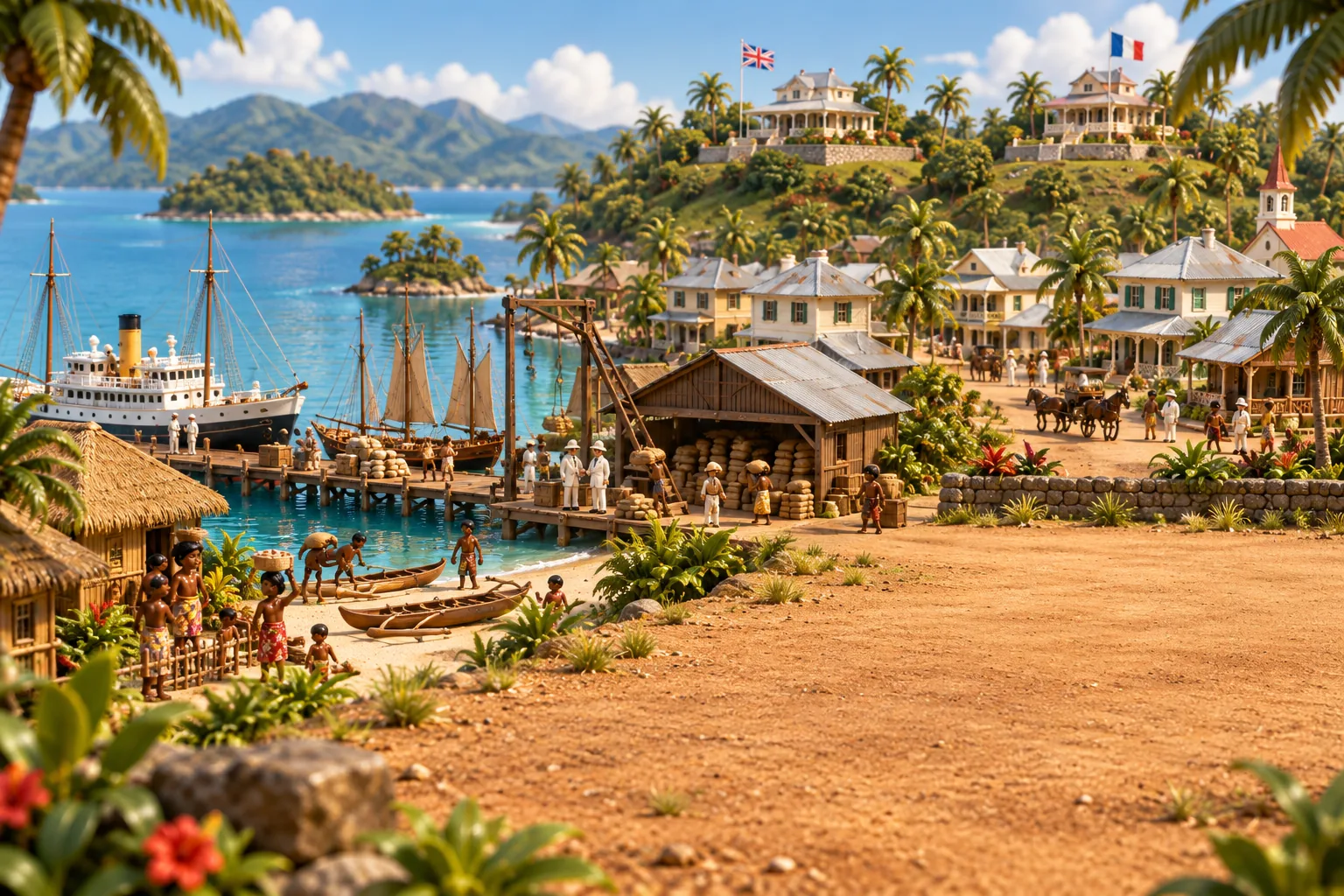
Britain and France ruled these islands together with two police forces, two school systems and two currencies, and cynics called it the Pandemonium.
People of the Lapita culture had settled the northern islands by 1300 BC. The first Europeans came with a Spanish expedition under the Portuguese navigator Pedro Fernandes de Queirós in 1606, and in 1774 James Cook named the islands after the Hebrides of Scotland. British, French, Australian and German settlers followed in the 19th century. In 1878 Britain and France declared the islands neutral, and from 1887 a joint naval commission kept order.
Under the Protocol of 1906 the two powers made the islands a condominium, ruled by both at once. There was a British administration, a French one and a joint one, and almost everything came in pairs: two police forces with their own laws, two health services, two school systems, two currencies and two prisons. Islanders could choose English common law or French civil law, and a Joint Court had a British judge, a French judge and a president named by the King of Spain. The Ni-Vanuatu themselves were officially stateless.
In the Second World War about 10,000 Ni-Vanuatu men served in a labour corps of the United States forces, which gave the John Frum movement on Tanna the character of a cargo cult. The islands became self-governing in 1978, and on 30 July 1980 they became independent as the Republic of Vanuatu, while a revolt on Espiritu Santo was put down in the short Coconut War.
Read more on Wikipedia
Sources: en.wikipedia.org/wiki/New Hebrides, en.wikipedia.org/wiki/Coconut War, en.wikipedia.org/wiki/John Frum