Industrial age · state
New Caledonia
France annexed New Caledonia in 1853 and shipped some 22,000 convicts there, among them rebels of the Paris Commune.
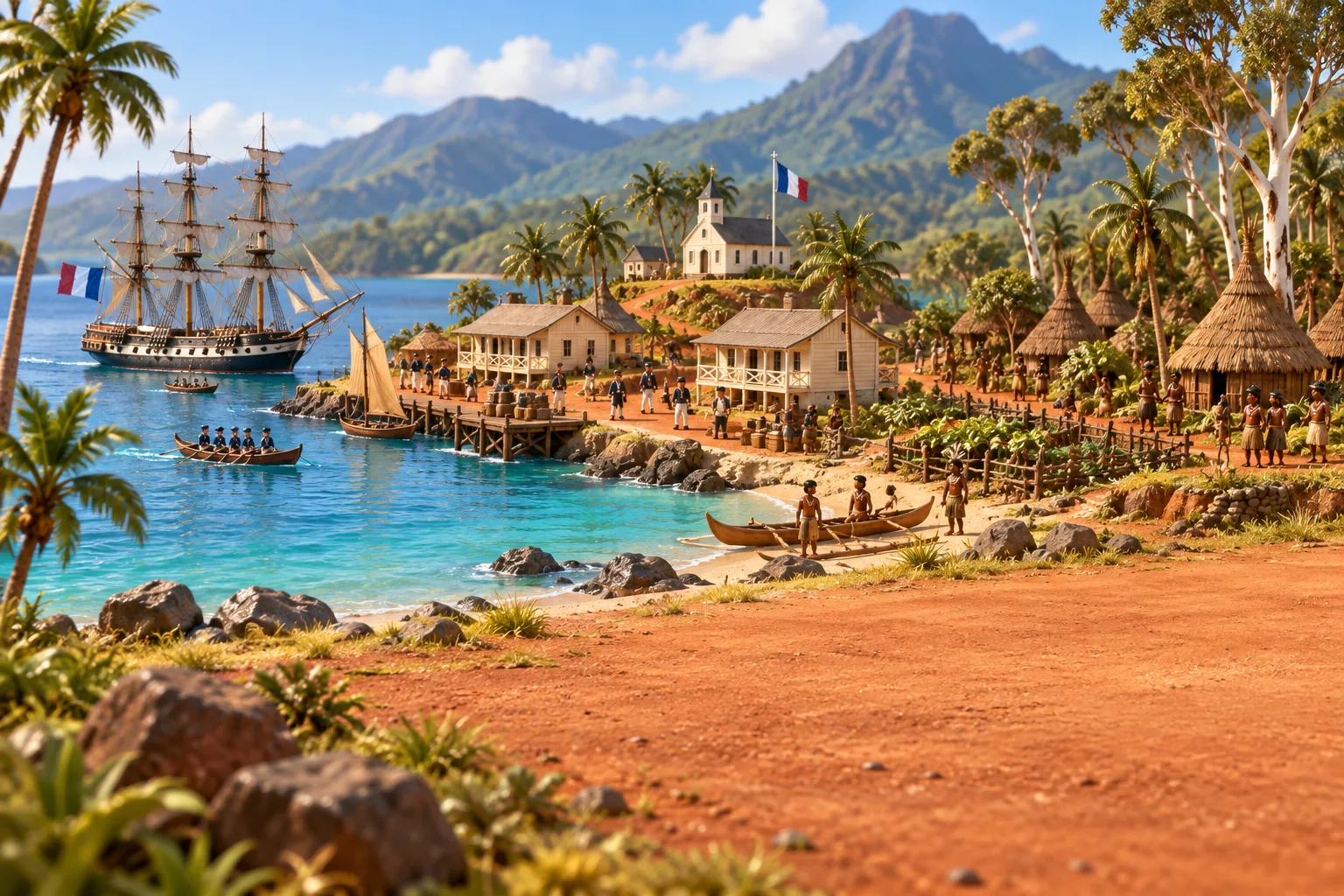
People of the Lapita culture reached the islands about three thousand years ago, and their descendants are the Kanak, organised in clans led by chiefs. James Cook sighted the main island on 4 September 1774 and named it after the Latin name of Scotland. Sandalwood traders followed, then blackbirders who carried islanders off to plantations. On 24 September 1853, on orders from Napoleon III, Admiral Febvrier Despointes took possession for France, and on 25 June 1854 Port-de-France, later Nouméa, was founded.
New Caledonia became a penal colony in 1864, and until 1897 France sent about 22,000 criminals and political prisoners, among them Communards such as Louise Michel. Nickel was found in 1864, and mining took off after 1876 with workers brought from the New Hebrides, Japan and Indochina. The Kanak were pushed onto reservations, and in 1878 High Chief Ataï led a war that killed 200 French and 1,000 Kanak. Disease cut the Kanak population from about 60,000 in 1878 to 27,100 in 1921.
In 1940 the colony sided with Free France, and in 1946 it became an overseas territory. Between 1976 and 1988 clashes over independence, known as the Events, ended in the Ouvéa cave hostage crisis. The Matignon Agreements of 26 June 1988 brought peace, and the Nouméa Accord of 5 May 1998 began a 20-year transfer of powers.
Read more on Wikipedia
Sources: en.wikipedia.org/wiki/New Caledonia