Middle Ages · state
Nara period
Japan's first permanent capital, Nara, cast a 16-metre bronze Buddha and wrote the oldest Japanese chronicles.
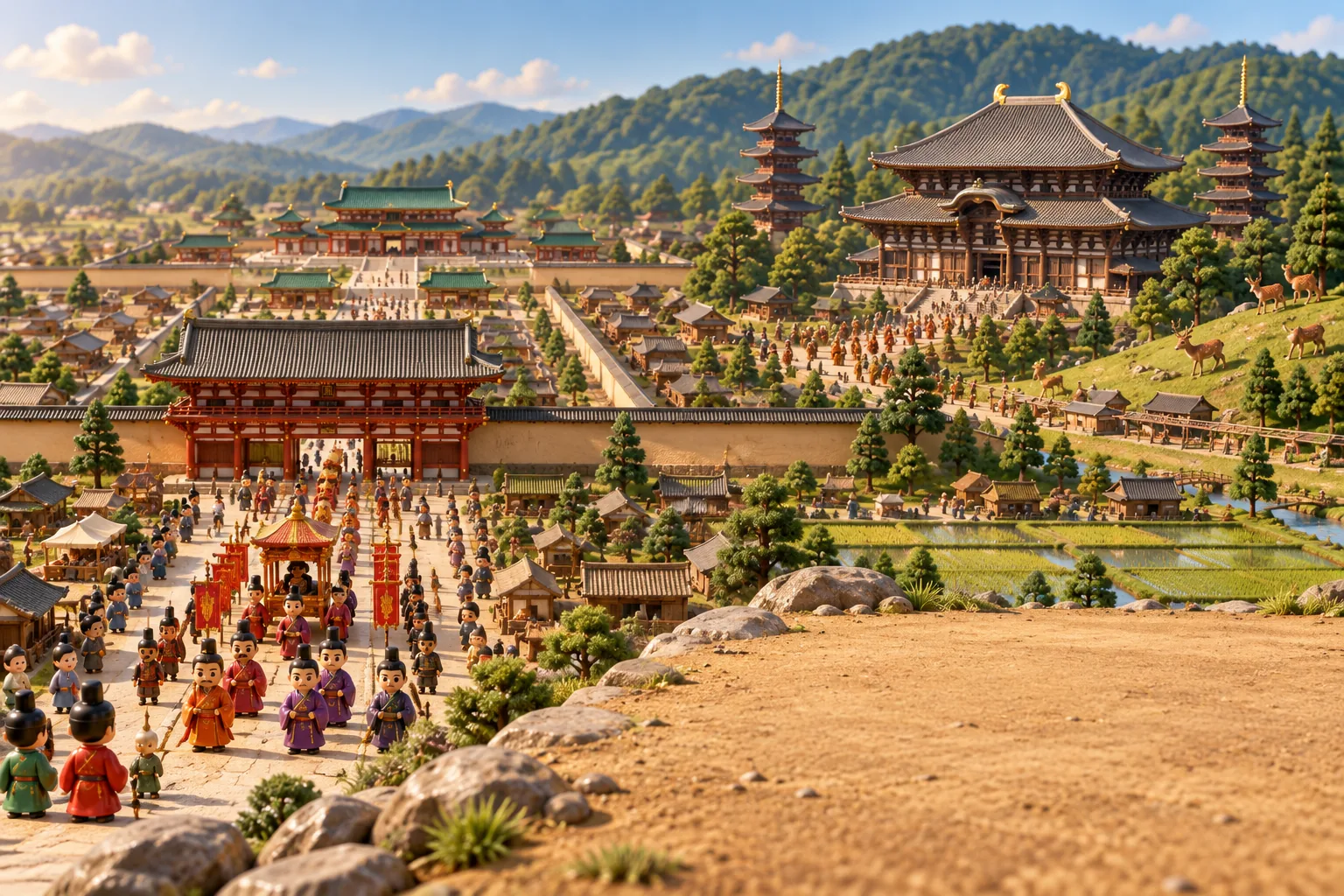
In 710 Empress Genmei moved the court to Heijō-kyō, today's Nara, a new capital laid out on the model of Chang'an, the capital of Tang China. Before that the capital had usually moved after an emperor died, but the new law codes and bureaucracy needed a permanent seat. Nara became Japan's first true city, with perhaps 200,000 people, some 10,000 of them in government jobs. Roads linked it to the provinces, taxes were collected more regularly and coins were minted.
The court took Chinese writing, fashion and schools of Buddhism, and sent envoys to the Tang court. It also wrote its own history: the Kojiki in 712 and the Nihon Shoki in 720, followed by the great poetry anthology, the Man'yōshū. After a smallpox epidemic in 735–737, Emperor Shōmu, a fervent Buddhist, ordered a Great Buddha for the temple of Tōdai-ji, a 16-metre gilt-bronze statue completed in 752, and founded temples in the provinces.
Shōmu's daughter reigned twice, as Empress Kōken and as Empress Shōtoku, and so favoured the monk Dōkyō that the court feared he would become emperor. After her death women were shut out of the succession. Feuds among the court families and the growth of private estates weakened the state, and Emperor Kanmu left Nara, moving the capital to Nagaoka in 784 and to Heian-kyō, modern Kyoto, in 794.
Read more on Wikipedia
Sources: en.wikipedia.org/wiki/Nara period, en.wikipedia.org/wiki/Tōdai-ji, en.wikipedia.org/wiki/Hyakumantō Darani

