
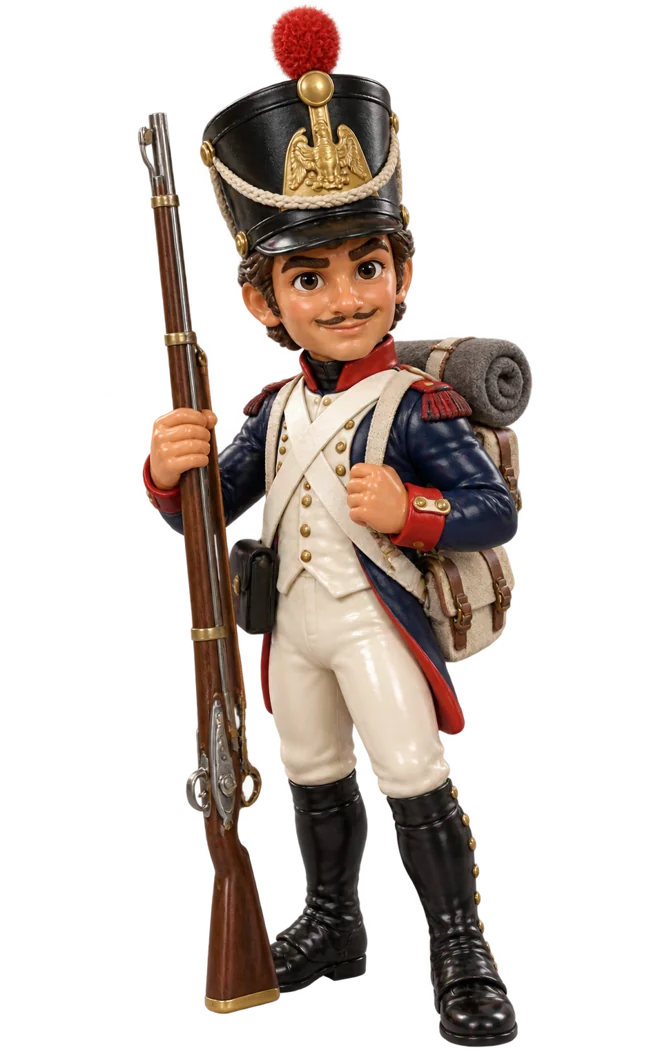
Industrial age · war
Napoleonic Wars
Of the 450,000 men Napoleon led into Russia in 1812, only about 27,000 fit soldiers were left by the time they struggled back across the Berezina.
The Napoleonic Wars grew out of the French Revolution. They began when Britain declared war on France on 18 May 1803, and they are counted as seven wars: five against coalitions of European powers, plus the Peninsular War in Spain and Portugal and the invasion of Russia. In 1805 Britain, Austria and Russia formed the Third Coalition. Napoleon, by then Emperor of the French, beat the Austrians at Ulm and on 2 December crushed an Austro-Russian army at Austerlitz in Moravia, usually considered his greatest victory. The Holy Roman Empire was dissolved soon after. At sea, though, Britain won at Trafalgar and kept control of the oceans.
In 1806 and 1807 Napoleon smashed Prussia at Jena-Auerstedt and the Russians at Friedland. To ruin Britain's trade he closed Europe's ports to it with the Continental System. In 1808 he made his brother Joseph King of Spain, and the Spanish rose against him, fighting a guerrilla, or "little war", backed by a British army. When Russia broke the blockade, Napoleon invaded it in June 1812 with a Grande Armée of 450,000 men. He took Moscow on 14 September, but hunger and the Russian winter destroyed his army on the retreat.
A Sixth Coalition beat him at Leipzig in October 1813, captured Paris in March 1814 and sent him to the island of Elba. He escaped in February 1815, ruled again for about a hundred days and lost at Waterloo in June. The Congress of Vienna then redrew the map of Europe.
Read more on Wikipedia


