Ancient world · culture
Mohenjo-daro
Four and a half thousand years ago, a city on the Indus had straight streets, covered drains and a well for every three houses.
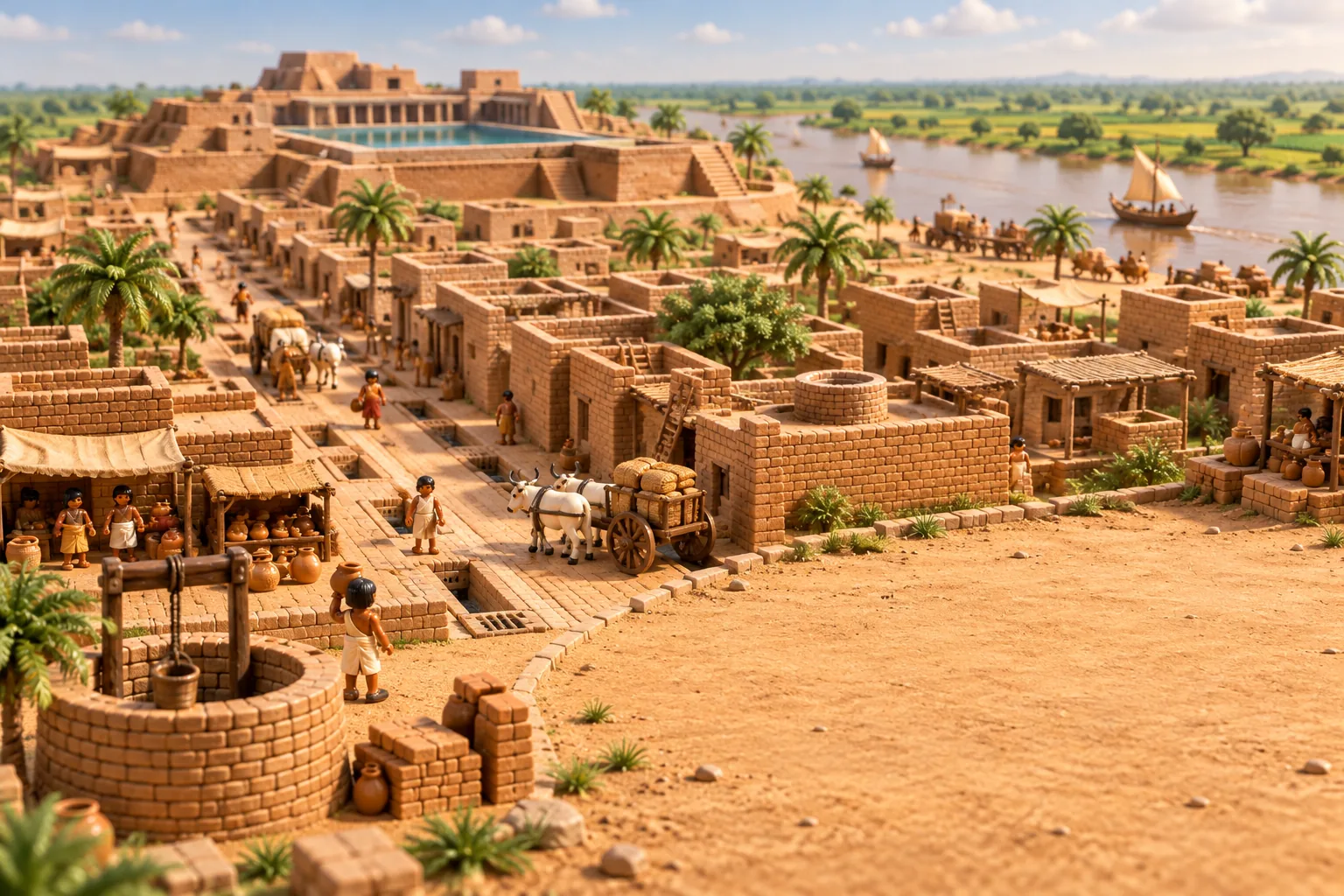
Around 2500 BC, on a ridge above the floodplain of the Indus in what is now Sindh, Pakistan, people built one of the world's earliest major cities. Mohenjo-daro may have held at least 40,000 people. Its houses, mostly of fired brick, stood along a grid of straight streets, and waste water ran into covered drains that lined the main roads.
Water shaped the whole city. Archaeologists have counted more than 700 wells, about one for every three houses, and the better houses had rooms set aside for bathing. On the raised mound known as the Citadel lies the Great Bath, a brick pool 12 metres long and 2.4 metres deep, sealed with bitumen and perhaps used for religious purification. Nobody knows what the people who lived here called their city; Mohenjo-daro is a modern Sindhi name meaning 'Mound of the Dead'.
By about 1700 BC the city had been abandoned, together with the other large cities of the Indus Valley Civilisation, and its ruins went undocumented for some 3,700 years. In 1919–1920, R. D. Banerji of the Archaeological Survey of India came to see a Buddhist stupa on the mound and picked up a flint scraper that told him the place was far older. Large excavations followed. In 1980 Mohenjo-daro became the first UNESCO World Heritage Site in South Asia; today erosion and poor restoration threaten it.
Read more on Wikipedia
Sources: en.wikipedia.org/wiki/Mohenjo-daro