
Early modern · person
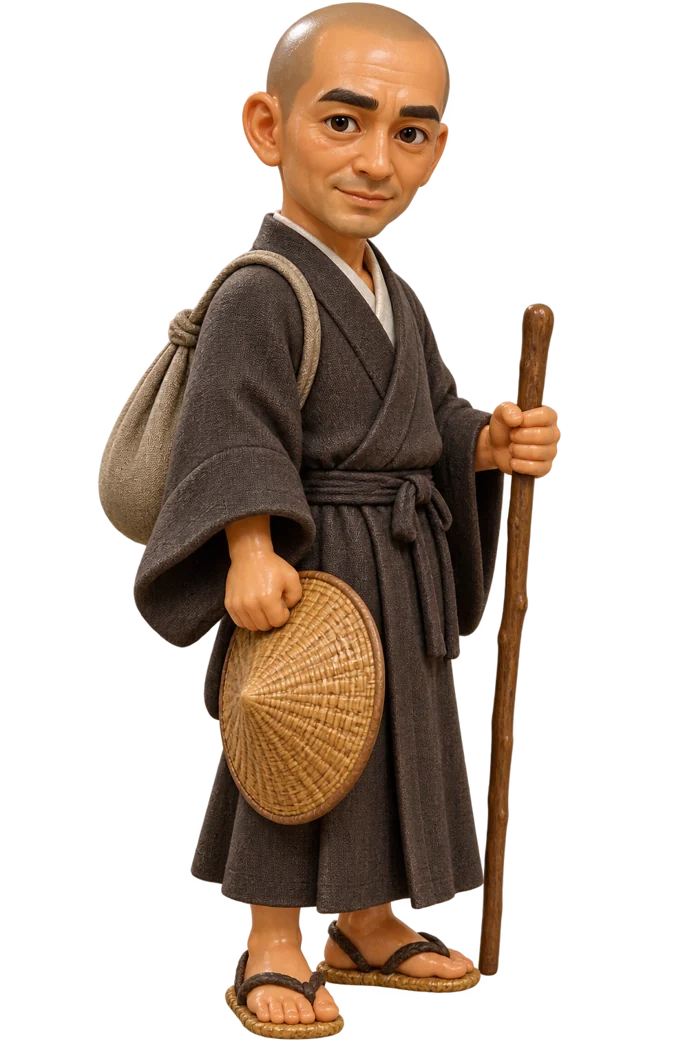
Matsuo Bashō
His disciples built him a rustic hut and planted a banana tree, a bashō, beside it; he took the plant's name, and in 1686 wrote there his frog poem, still one of the best-remembered haiku.
Matsuo Kinsaku was born in 1644 near Ueno in Iga Province, into a family of samurai descent. In his late teens he became a servant to Tōdō Yoshitada, who shared his love of haikai, the linked verse whose opening 5-7-5 lines, the hokku, would much later be called haiku. His first known poem was published in 1662. When Yoshitada died suddenly in 1666, Bashō gave up any hope of samurai rank and left home.
He settled in Edo, studied with Kitamura Kigin and in 1675 took the pen name Tōsei; by 1680 he had twenty disciples and a living as a teacher. That winter he moved across the river to quiet Fukagawa, where his followers built him a hut and planted a banana tree, a bashō, which gave him his name. The hut burned in 1682, but his disciples built another. In early 1686 he wrote his poem of a frog leaping into an old pond, and that April the poets of Edo held a frog contest in its honour. On 16 May 1689 he left Edo with his student Kawai Sora on the long walk to the northern provinces that became The Narrow Road to the Deep North.
He finished it in 1694 and left Edo for the last time that summer. In Osaka he fell ill with a stomach complaint and died among his disciples on 28 November 1694. The book appeared in 1702 and became an instant success.
Read more on Wikipedia
Sources: en.wikipedia.org/wiki/Matsuo Bashō, en.wikipedia.org/wiki/Oku no Hosomichi