
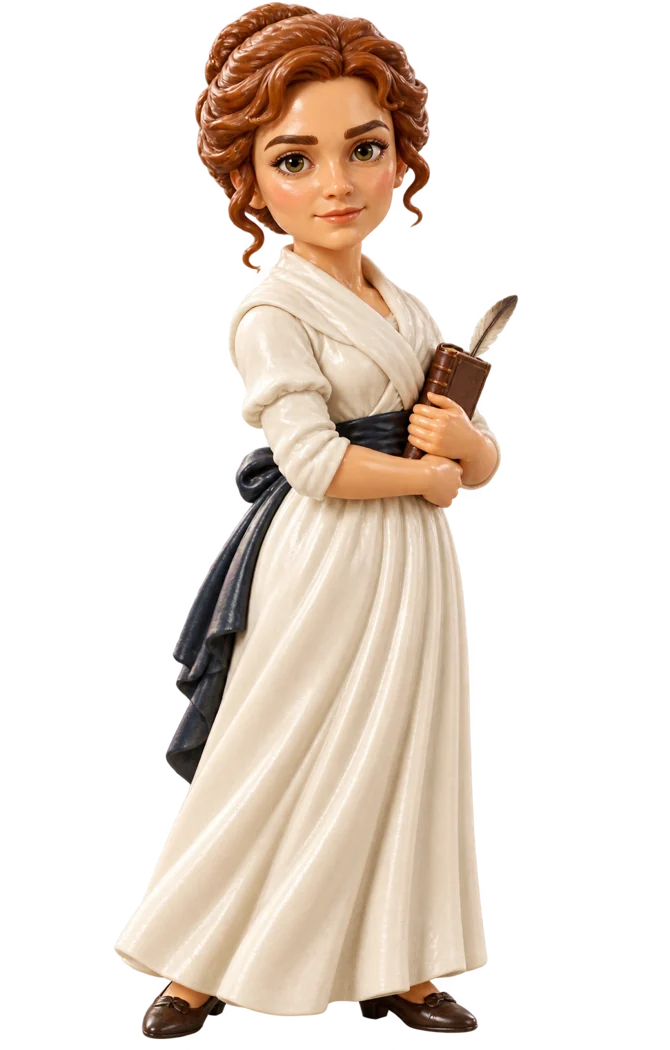
Early modern · person
Mary Wollstonecraft
In 1792 a former governess turned writer told her readers that women are not born inferior to men: they only seem so because no one lets them learn.
Mary Wollstonecraft was born on 27 April 1759 in Spitalfields, London, the second of seven children. In 1778 she left an unhappy home to work as a lady's companion in Bath, and with her sisters and her closest friend Fanny Blood she later opened a school at Newington Green, a community of Dissenters. After Blood's death in 1785 she became a governess to the Kingsborough family in Ireland, then decided to live by her pen, writing to her sister in 1787 that she would be "the first of a new genus".
In London the publisher Joseph Johnson gave her work translating and reviewing, and at his dinners she met Thomas Paine and William Godwin. When Edmund Burke attacked the French Revolution, she answered him in A Vindication of the Rights of Men, published on 29 November 1790, and became famous overnight. In 1792 came A Vindication of the Rights of Woman, arguing that women only appear inferior because they lack education and that both sexes should be treated as rational beings. That December she left for Paris.
In France she fell in love with the American Gilbert Imlay, and on 14 May 1794 gave birth to their daughter Fanny, but the affair ended badly. Back in London she grew close to Godwin; they married on 29 March 1797 and moved to 29 The Polygon in Somers Town. On 30 August she gave birth to a second daughter, Mary, but the placenta became infected and she died on 10 September 1797, aged 38. That baby grew up to write Frankenstein.
Read more on Wikipedia


