Our time · politics
Mao and the new China
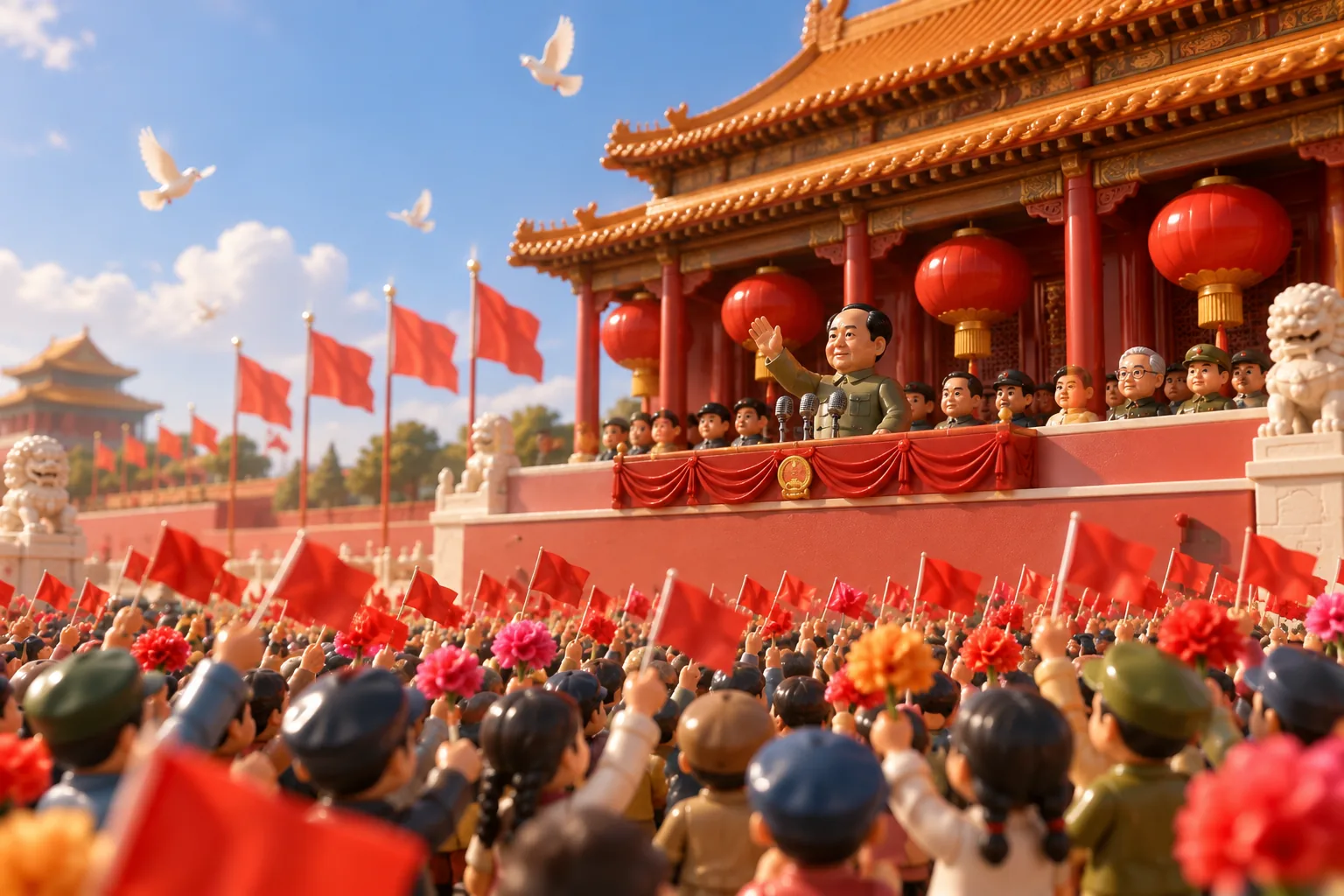
At exactly three in the afternoon a farmer's son from Hunan stood on the gate of the old imperial palace and announced a new China.
Mao Zedong was born on 26 December 1893 into a peasant family near Shaoshan, in Hunan province. As a young man he read Adam Smith, Darwin and Rousseau in the library in Changsha, and later worked as an assistant to the librarian of Peking University, where he discovered Marxism. In 1921 he was a founding member of the Chinese Communist Party. He built its Red Army and its strategy of guerrilla war, and in 1935, during the Long March, became the party's leader.
The Communists' civil war with Chiang Kai-shek's Nationalists paused while both fought Japan, then resumed after 1945. By 1949 the Communists held most of mainland China. On 1 October 1949, at 15:00 Beijing time, Mao stood on top of Tiananmen Gate before a vast crowd and announced: "Fellow countrymen, the Central People's Government of the People's Republic of China was established today!" The new anthem, "March of the Volunteers", was played, the Five-starred Red Flag was raised for the first time to a 21-gun salute, and the People's Liberation Army held its first public parade. By December the Nationalist government had retreated to Taiwan.
Mao ruled until his death in 1976. He redistributed land and spread literacy and basic healthcare, but his Great Leap Forward from 1958 led to the Great Chinese Famine, and his Cultural Revolution from 1966 unleashed years of violence. His rule caused tens of millions of deaths.
Read more on Wikipedia
Sources: en.wikipedia.org/wiki/Mao Zedong, en.wikipedia.org/wiki/Proclamation of the People's Republic of China