Early modern · state
Malacca Sultanate
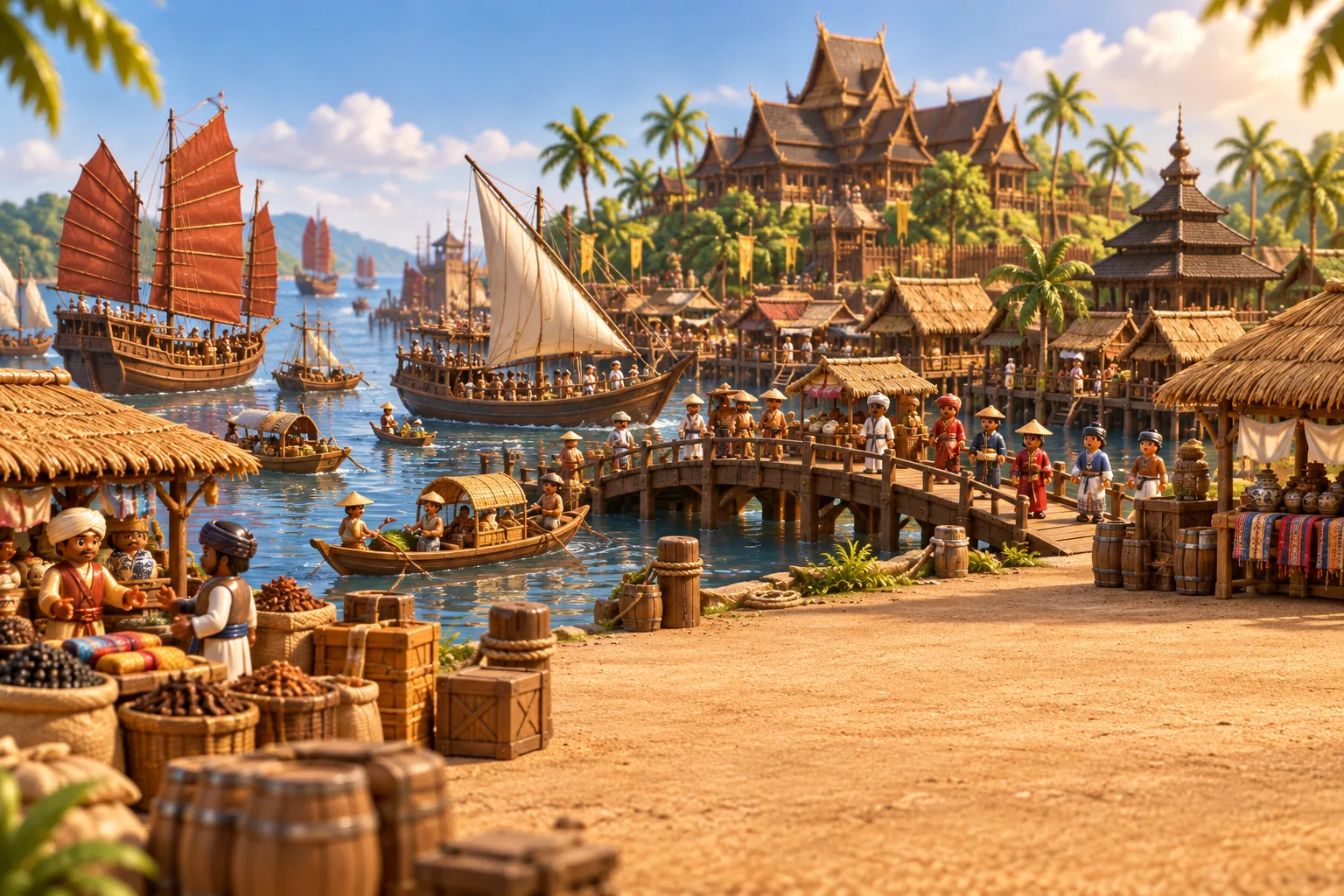
A prince who watched a mouse deer kick his hunting dog into a river founded a port so rich that a Portuguese writer said its lord held Venice by the throat.
Around 1400 Parameswara, the last king of Singapura, fled north and founded a new town on the Malacca River, on the strait between the Indian Ocean and the South China Sea. Sea nomads, the Orang Laut, patrolled the waters against pirates and steered traders to his port. In 1405 the Yongle Emperor of Ming China sent an envoy, and the admiral Zheng He called at Malacca on his voyages, making it a protected friend of China.
Its rulers became Muslim sultans, and Malacca grew into a centre of Islamic learning from which the faith spread across the archipelago, while Classical Malay became the common language of the region's ports. Under Sultan Mansur Shah (1459–1477) and his bendahara, or chief minister, Tun Perak, a fleet of two hundred ships conquered Pahang, and the sultanate came to rule much of the Malay Peninsula and the coast of Sumatra opposite. Spices from the Moluccas passed through it on their way to India, Arabia and Venice.
Portugal wanted that trade. Afonso de Albuquerque arrived in April 1511, and after a failed assault on 25 July he took the city on 15 August. The last sultan, Mahmud Shah, retreated south, and his sons founded the sultanates of Johor and Perak.
Read more on Wikipedia

