Middle Ages · state
Majapahit
From a brick capital in east Java, it claimed tribute from Sumatra to New Guinea after its prime minister Gajah Mada swore not to rest until the islands were united.
In 1293 a Mongol fleet sent by Kublai Khan landed on Java to punish King Kertanegara of Singhasari, whom the rebel Jayakatwang of Kediri had already killed. Kertanegara's son-in-law Raden Wijaya had built a village on timberland at Trowulan and named it Majapahit, after a bitter fruit. He joined the Mongols to defeat Jayakatwang, then turned on his allies and drove them out. He was crowned on 10 November 1293.
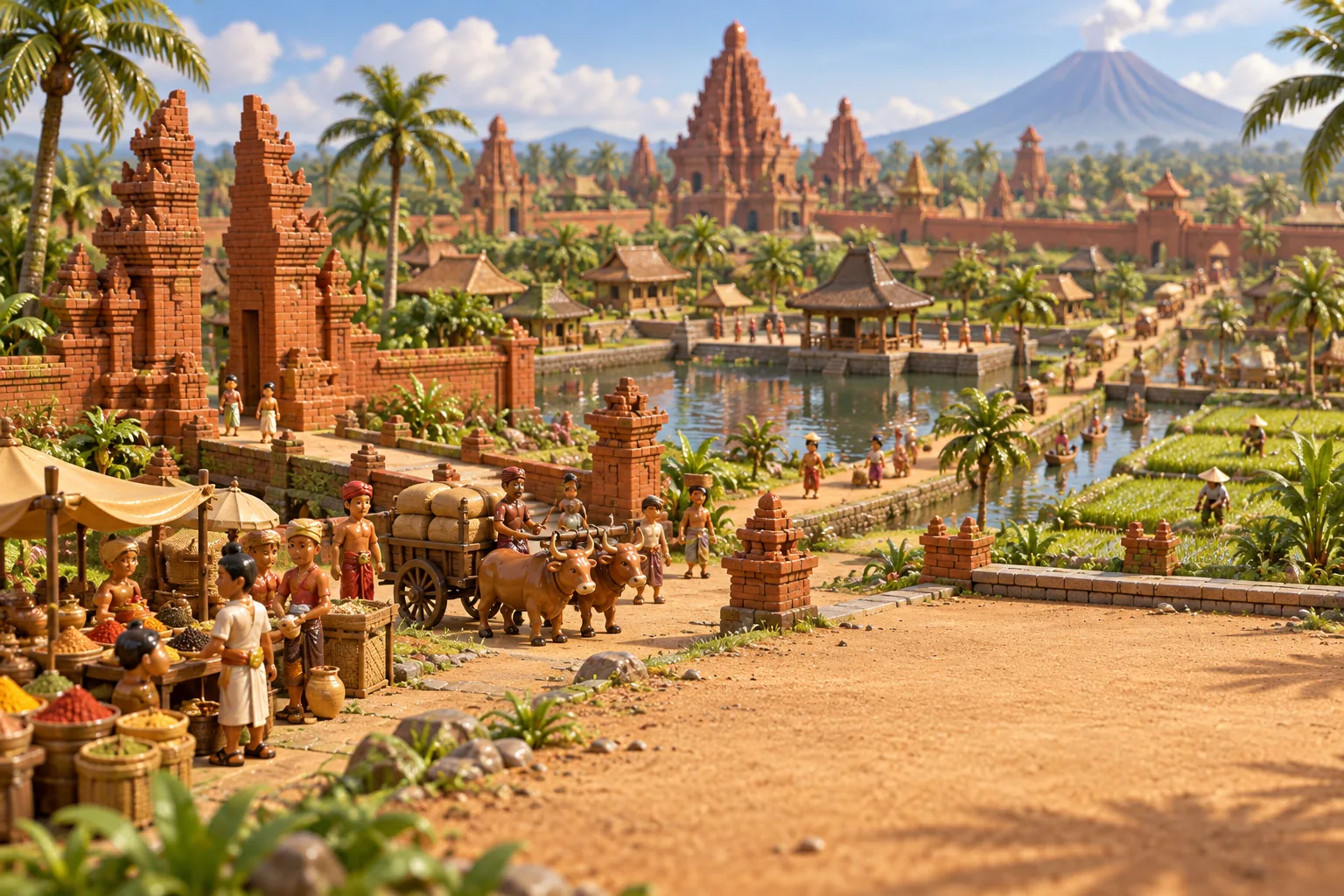
In 1336 Queen Tribhuwana made Gajah Mada her prime minister, and he swore the Palapa oath to unite the archipelago. Under her son Hayam Wuruk, who reigned from 1350 to 1389, Majapahit reached its peak. The court poem Nagarakretagama, written in 1365 by Mpu Prapanca, lists tributaries from Sumatra and the Malay Peninsula to Borneo, Maluku and New Guinea, though direct rule covered only east Java and Bali. The capital at Trowulan was laced with canals and built of red brick, and visitors described a court full of cloves and nutmeg.
After Hayam Wuruk died, his heirs fought the Regreg civil war of 1405 to 1406, which drained the treasury and weakened its grip on the outer islands. Ming China backed Malacca as a rival port, and Islam spread along Java's north coast. In 1468 the court split between Trowulan and Daha. The Sultanate of Demak crushed Majapahit in 1527, and many courtiers, priests and artisans fled to Bali.
Read more on Wikipedia
Sources: en.wikipedia.org/wiki/Majapahit


