Ancient world · culture
Magna Graecia
The letters you are reading travelled from a Greek colony near Naples to the Etruscans, and from them to Rome.
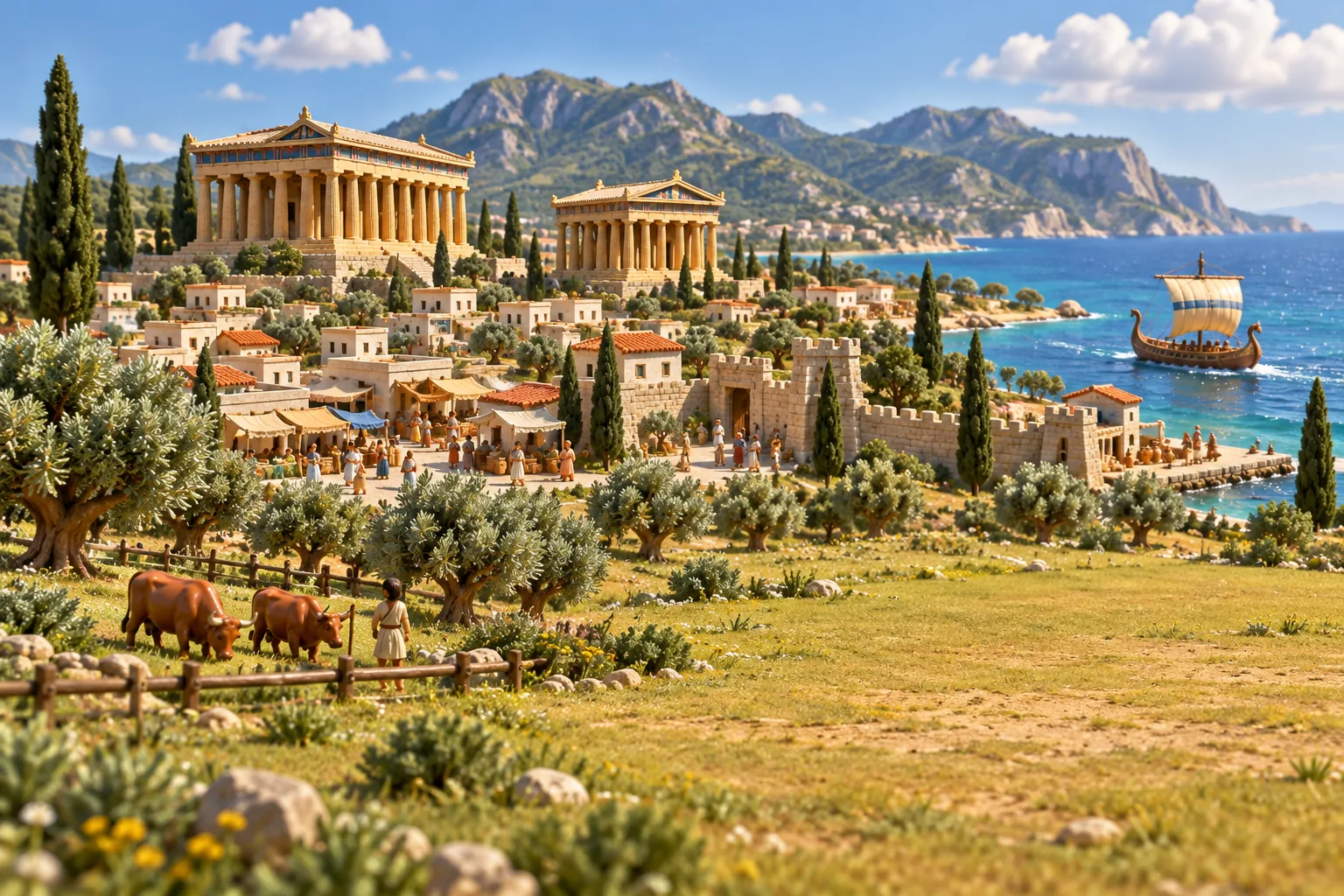
In the 8th century BC Greeks began to settle along the coasts of southern Italy. First came Euboeans, who founded Pithekoussai on the island of Ischia, the oldest Greek settlement in Italy, and then Cumae, their first colony on the mainland, as well as towns on the Strait of Messina. Shortly before 720 BC Achaeans settled the Ionian coast at Sybaris, Kroton, Metapontion and Poseidonia. The colonies grew into rich independent city-states and founded new colonies of their own. The region came to be called Megálē Hellás, "Great Greece", in Latin Magna Graecia.
Some of these cities outshone the old Greek homeland in architecture and town planning. Sybaris was the largest, with perhaps 300,000 to 500,000 people between 600 and 510 BC, until Kroton, led by the famous athlete Milo, destroyed it in 510 BC. Pythagoras founded his school at Kroton around 530 BC. In Sicily, Gelon of Syracuse beat Carthage at Himera in 480 BC, and in 474 BC Syracuse's fleet helped Cumae defeat the Etruscans. Naples, Taranto, Reggio and Crotone all began as Greek cities.
The Greek cities often fought one another, and Rome slowly absorbed them; their independence ended in the Second Punic War, and by 205 BC they had all been annexed. But their culture lasted. The Cumaean form of the Greek alphabet, adopted by the Etruscans, grew into the Latin alphabet.
Read more on Wikipedia
Sources: en.wikipedia.org/wiki/Magna Graecia


