
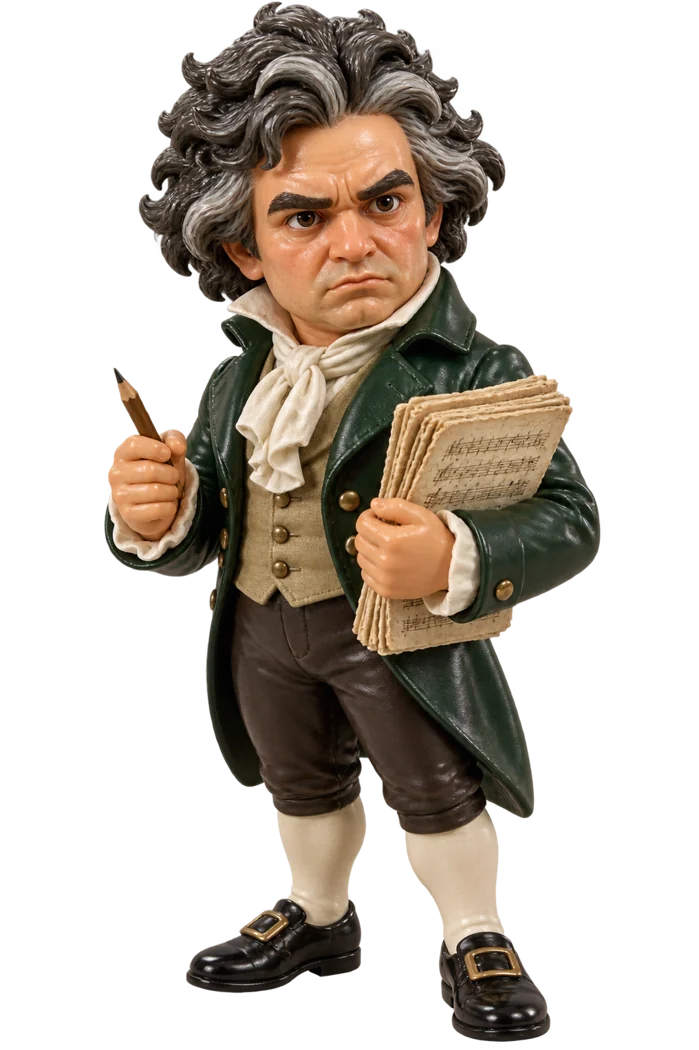
Industrial age · person
Ludwig van Beethoven
He had been losing his hearing for over twenty years when Vienna heard his Ninth Symphony, the one that ends with a choir singing the Ode to Joy.
Ludwig van Beethoven was baptised in Bonn on 17 December 1770, probably a day after his birth. His father Johann, a tenor at the Bonn court, taught him intensively, and from about 1780 his real teacher was the court organist Christian Gottlob Neefe. In 1792, aged 21, he moved to Vienna to study composition with Joseph Haydn, and the city stayed his home for the rest of his life. He made his name as a virtuoso pianist, supported by aristocratic patrons such as Prince Lichnowsky.
His hearing began to fail around 1798. In 1802, at Heiligenstadt outside Vienna, he wrote a letter to his brothers confessing thoughts of suicide and his resolve to live for his art. What followed was his heroic period: the Eroica Symphony, the Fifth, the opera Fidelio and the Violin Concerto. Later, visitors wrote their side of the talk in notebooks, his conversation books. In 1823 he finished the Missa solemnis and the Ninth Symphony, and on 7 May 1824 the Ninth was first performed at the Kärntnertortheater in Vienna, to great acclaim.
After months in bed with illness, Beethoven died in Vienna on 26 March 1827, aged 56. About 10,000 people followed his funeral procession. In 1888 his remains were moved to the Zentralfriedhof and laid next to Franz Schubert. His symphonies, sonatas and quartets are among the most performed music in the world.
Read more on Wikipedia


