Middle Ages · state
Latin Empire
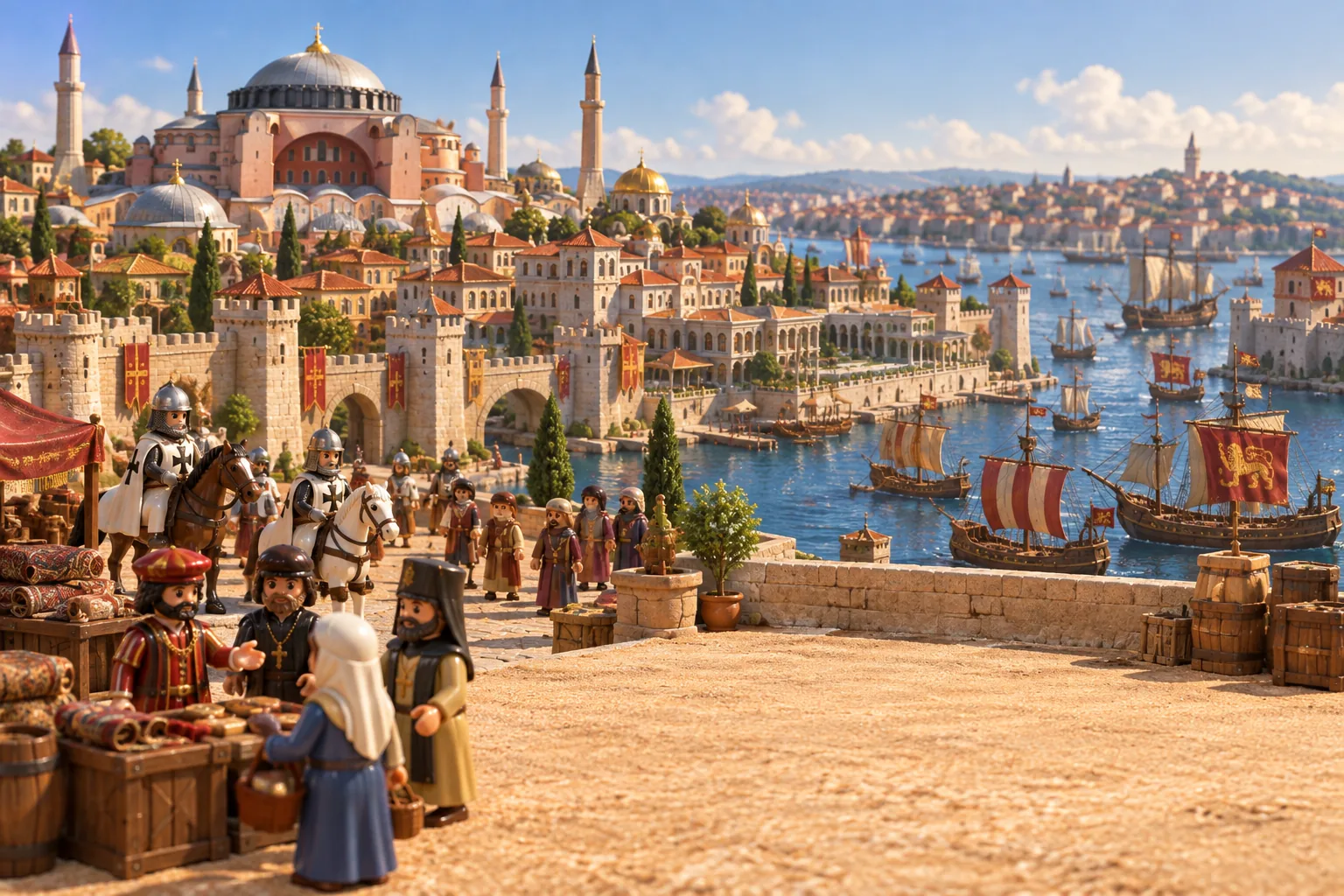
Crusaders who set out for Jerusalem crowned a count of Flanders in Hagia Sophia instead, and his heirs ended up selling the palace roof.
The Fourth Crusade was called to retake Jerusalem, but money troubles and a deal with the exiled Byzantine prince Alexios IV led it to Constantinople. When the promised money did not come, the crusaders stormed and plundered the city in April 1204. On 9 May they elected Count Baldwin IX of Flanders emperor, and he was crowned in Hagia Sophia on 16 May. A treaty of 1 October 1204 gave three-eighths of the empire to Venice, and Frankish lords took Thessalonica, Achaea and Athens as vassal states.
The new empire was attacked at once. On 14 April 1205 the Bulgarian tsar Kaloyan crushed the Latin knights at Adrianople and captured Baldwin, who died in prison. His brother Henry of Flanders, emperor from 1206 to 1216, beat the Bulgarians and the Nicaeans, won back Thrace and treated his Greek subjects fairly, and is remembered as a wise and tolerant ruler.
After Henry the empire shrank. Epirus took Thessalonica in 1224, and Nicaea took the lands in Asia. On the night of 24 to 25 July 1261, while the garrison and the Venetian fleet were away on a raid, the Nicaean general Alexios Strategopoulos slipped into the city with about 800 men. Baldwin II fled by ship, and Michael VIII Palaiologos restored the Byzantine Empire.
Read more on Wikipedia
Sources: en.wikipedia.org/wiki/Latin Empire, en.wikipedia.org/wiki/Henry of Flanders

