
Early modern · state
Kingdom of France
One family and its branches ruled France for more than 800 years, until a king who had inherited the Sun King's crown lost his head in 1793.
The kingdom grew out of West Francia, the share of Charlemagne's empire that went to Charles the Bald by the Treaty of Verdun in 843. In 987 the magnates elected Hugh Capet, Duke of France and Count of Paris, as king, and his Capetian dynasty and its branches, the Valois and the Bourbons, ruled for more than 800 years. Philip II, in 1190, was the first to call himself King of France rather than King of the Franks.
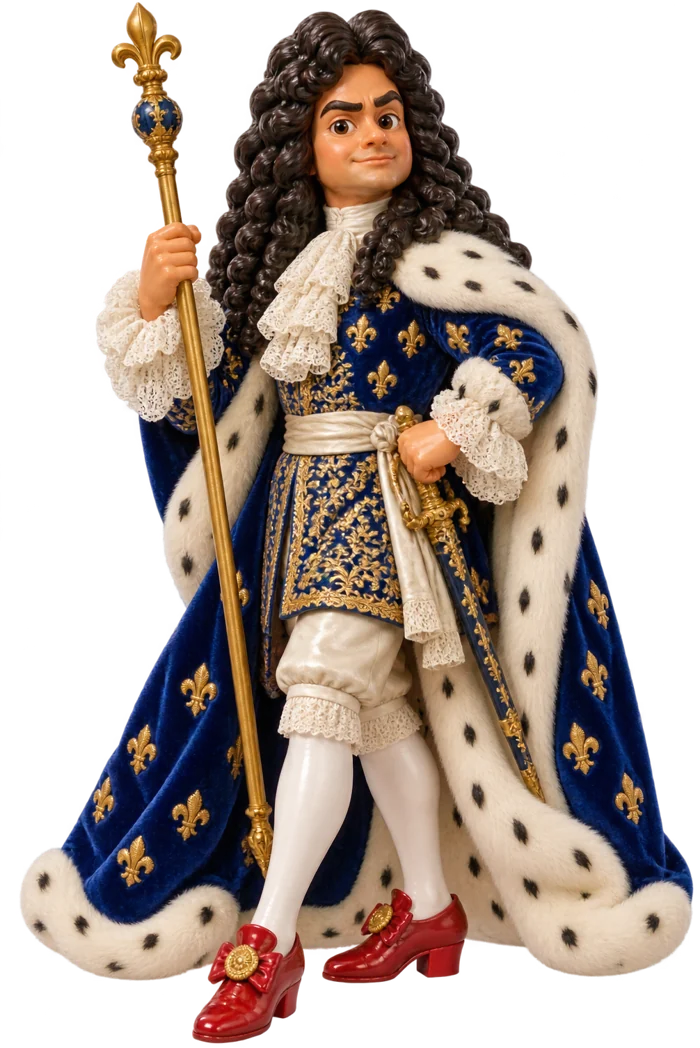
When the direct Capetian line died out, Salic law barred the crown from passing through Isabella of France to her son Edward III of England, and the dispute became the Hundred Years' War. The Black Death arrived from Italy in 1348. The Wars of Religion between Catholics and Huguenots raged from 1562 to 1598, until the Protestant Henry IV, first of the Bourbons, gave up Protestantism. Under Cardinal Richelieu and then Louis XIV, the Sun King, who reigned from 1643 to 1715, France was the dominant power in Europe, and Louis kept his nobles at his palace of Versailles.
Louis XIV revoked the Edict of Nantes in 1685. Under Louis XV the Seven Years' War cost France most of New France in North America by 1763. A deep financial crisis brought the Revolution of 1789, the monarchy was abolished on 21 September 1792, and Louis XVI was guillotined on 21 January 1793.
Read more on Wikipedia

