Middle Ages · state
Kingdom of Cornwall
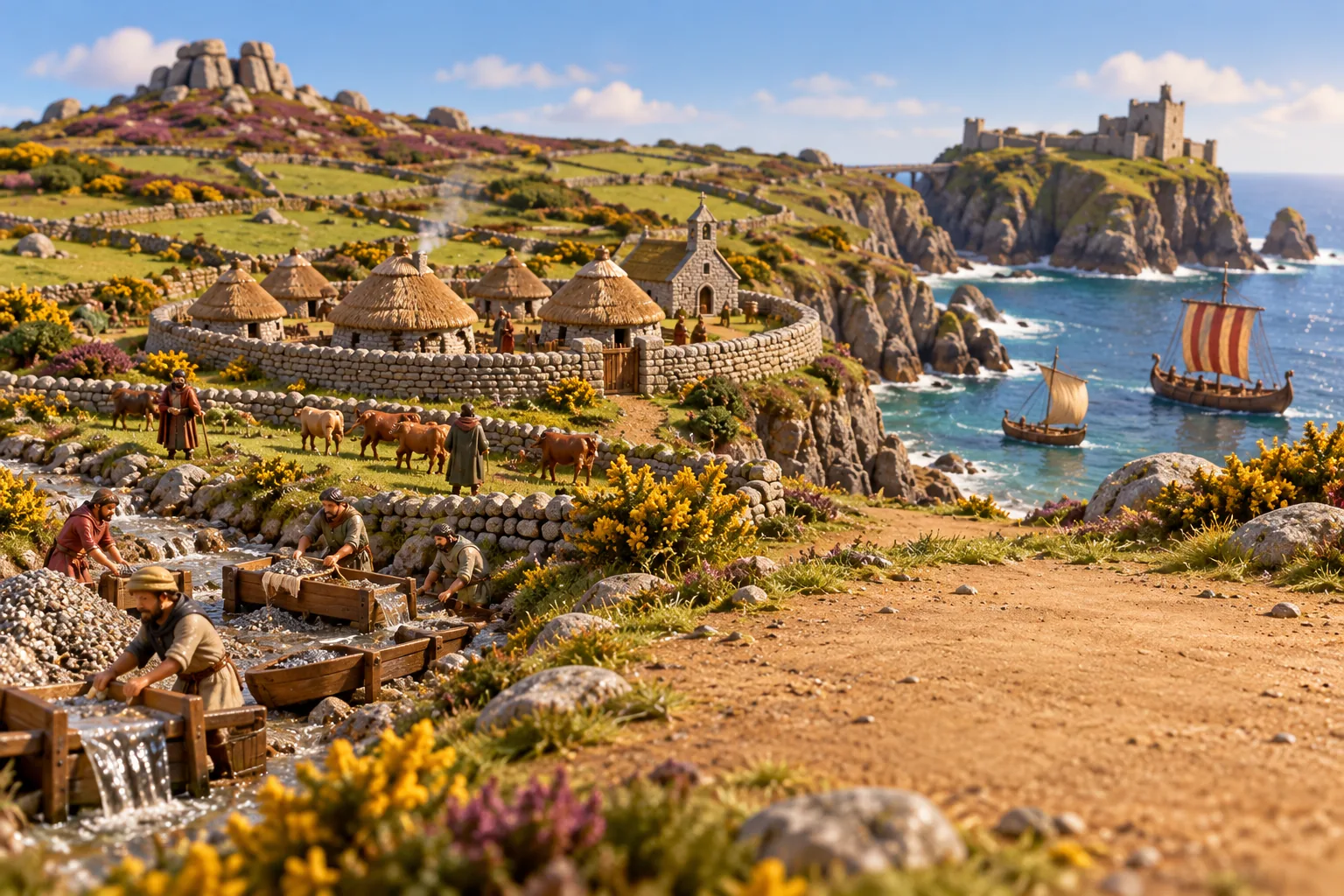
At the far tip of Britain, Celtic kings of the tin country held off the Anglo-Saxons for two hundred years, and the River Tamar still marks their border.
After Roman rule ended, Cornwall was the western end of Dumnonia, a kingdom of the Britons that also took in Devon. Its people spoke the Celtic tongue that became Cornish, sold tin across the sea and kept close ties with Wales, Brittany and Ireland. The headland stronghold of Tintagel was a seat of power in the early sixth century, and Celtic saints such as Piran, later the patron saint of Cornwall, spread the Christian faith.
From the seventh century the Anglo-Saxon kingdom of Wessex pushed west. In 710 Geraint, king of Dumnonia, fought Ine of Wessex, and in 814 King Egbert of Wessex ravaged Cornwall from east to west. In 838 the Cornish joined forces with Danish Vikings, but Egbert defeated them at Hingston Down. The Welsh annals record that Dungarth, king of Cornwall, drowned in 875, though by then he was probably only an under-king.
According to William of Malmesbury, King Æthelstan expelled the Cornish from Exeter around 927 and fixed their eastern border at the River Tamar, where the boundary of Cornwall still runs. He also founded a bishopric for Cornwall at St Germans. Cornwall became part of England but kept its language and customs for centuries.
Read more on Wikipedia
Sources: en.wikipedia.org/wiki/History of Cornwall, en.wikipedia.org/wiki/Cornwall