Middle Ages · state
Kingdom of Asturias
A small victory in a mountain valley in 722 became the founding legend of Christian Spain, and its kings later claimed the tomb of an apostle.
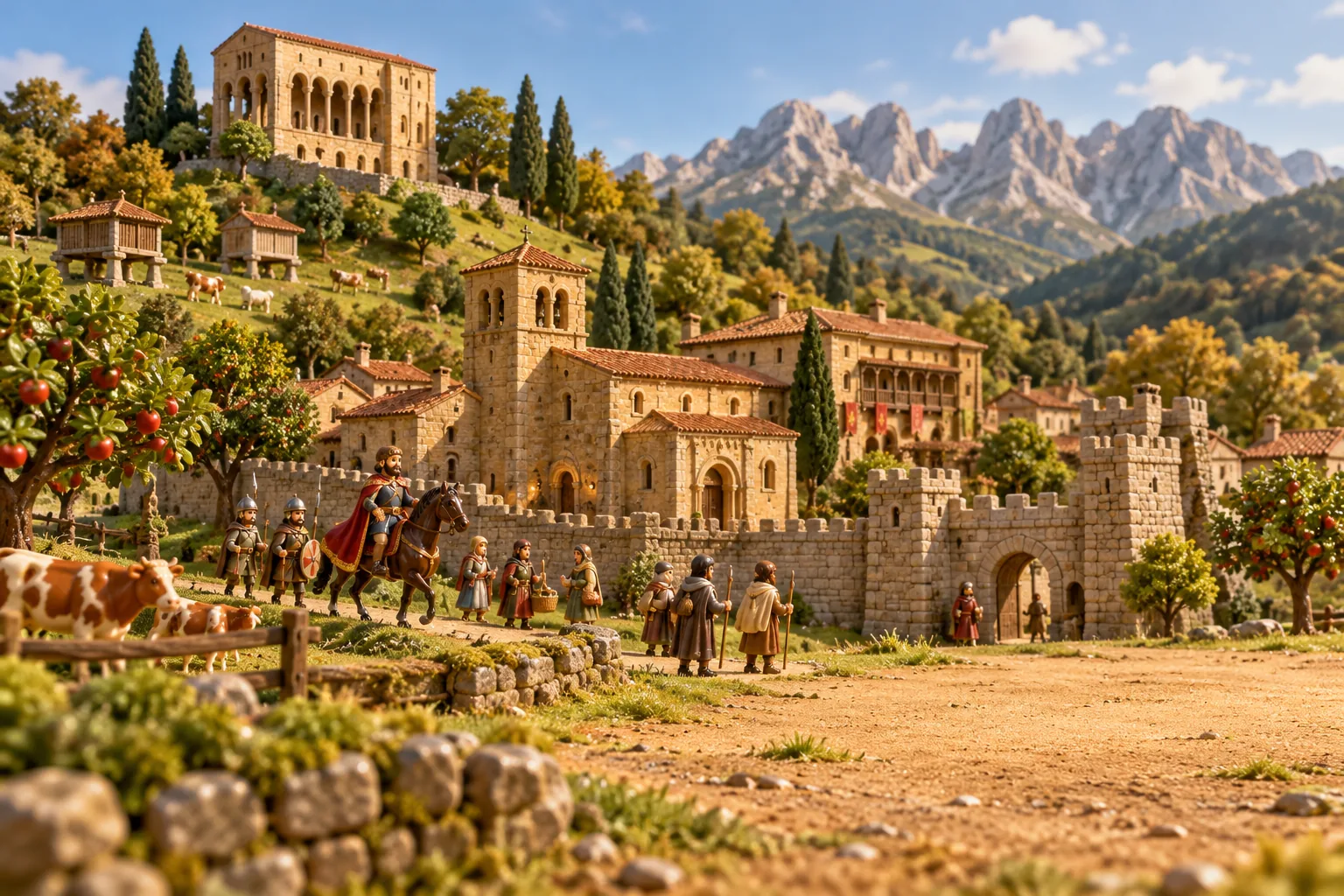
After the Umayyad conquest of Visigothic Hispania began in 711, the nobleman Pelagius, or Pelayo, led a revolt in the mountains of Asturias. In the summer of 722 he defeated an Umayyad force at Covadonga, a battle later hailed as the start of the Reconquista. His small state, the first Christian kingdom in Iberia after the conquest, had its first capital at nearby Cangas de Onís. Pelayo's dynasty slowly grew, and by about 775 it held most of north-western Iberia.
Alfonso II (791–842) made his birthplace Oviedo the capital and was recognised as king by Charlemagne and the pope. In his reign the bones of Saint James were declared found at Compostela in Galicia, and pilgrims from all over Europe began walking the Way of Saint James. His successor Ramiro I beat a Viking fleet at Corunna in 844 and built a palace on Mount Naranco above Oviedo.
Under Alfonso III (866–910), helped by the breakdown of Umayyad control in al-Andalus, the frontier advanced south to the Douro and the Mondego. In 910 his sons forced him to abdicate and divided the realm into León, Galicia and Asturias, and in 924 it passed to the crown of León.
Read more on Wikipedia
Sources: en.wikipedia.org/wiki/Kingdom of Asturias, en.wikipedia.org/wiki/Santa María del Naranco, en.wikipedia.org/wiki/Victory Cross