Industrial age · state
Khanate of Khiva
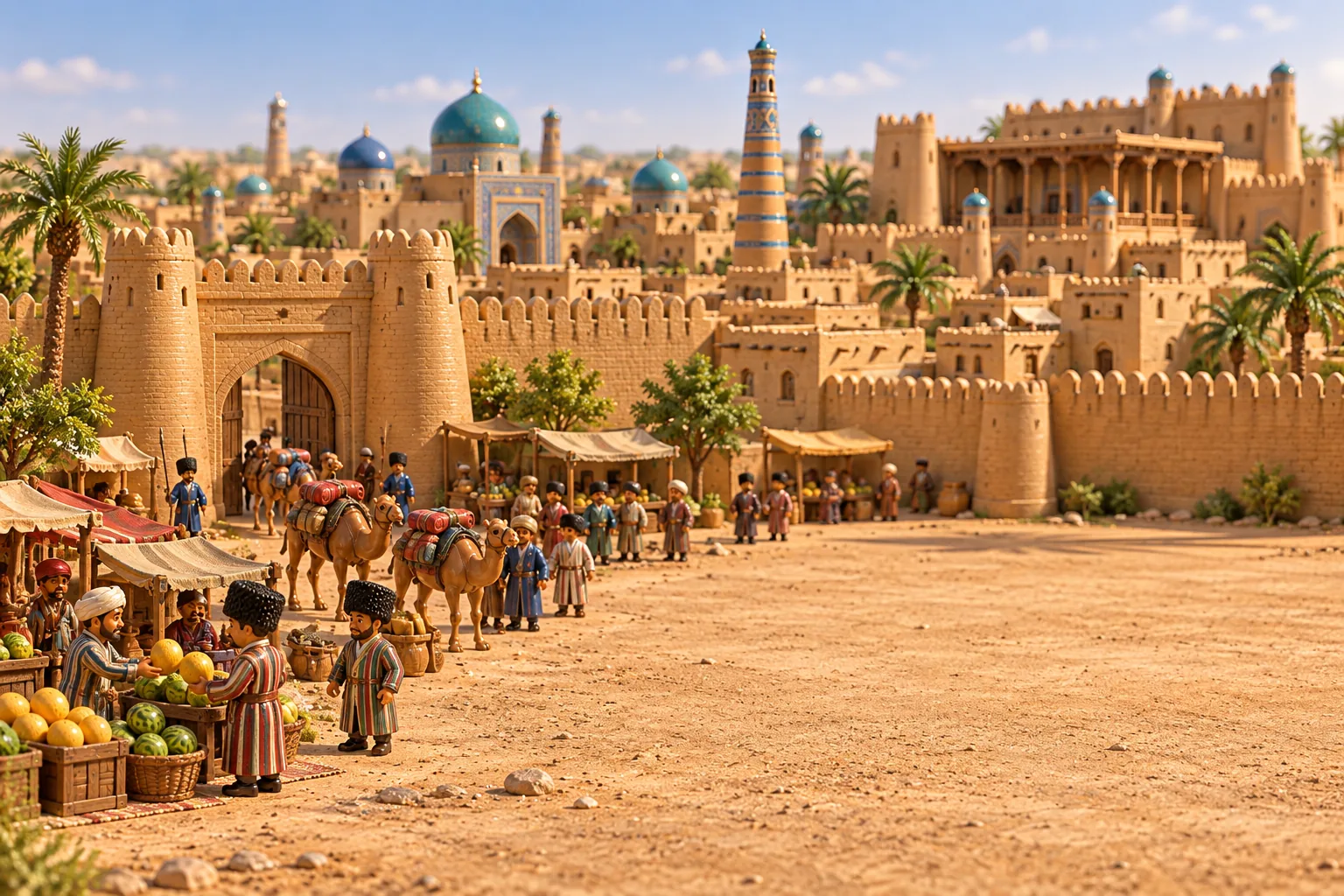
Khiva's slave market sold Persian and Russian captives for centuries, until Russian troops took the city in 1873 and freed them.
In 1511 an Uzbek dynasty took over Khorezm, the irrigated plains of the lower Amu Darya south of the Aral Sea. Its people called their country Khwarazm; the name Khanate of Khiva came from the Russians. The capital was first Old Urgench, but around 1600 a branch of the river dried up and the court moved south to Khiva. From 1740 to 1746 the Persian conqueror Nader Shah occupied the khanate.
After 1746 the Qongrat tribe ruled through puppet khans, and in 1804 Iltuzar Khan made them the ruling dynasty. Khiva flourished under Muhammad Rahim Khan, who reigned from 1806 to 1825, and Allah Quli Khan, until 1840. Turkmen raiders brought Persian and Russian captives to its markets. Russia tried to take the oasis in 1717, when the force of Alexander Bekovich-Cherkassky was killed or enslaved, and again in the winter of 1839, when General Perovsky turned back after losing many men and most of his camels.
In 1840 a young British officer, Richmond Shakespear, persuaded the khan to free all Russian subjects. In 1873, after taking Tashkent and Samarkand, General von Kaufmann marched on Khiva with 13,000 men, captured it and forced Muhammad Rahim Khan II to free all slaves. The khanate became a Russian protectorate, and in 1920 it was replaced by the Khorezm People's Soviet Republic.
Read more on Wikipedia
Sources: en.wikipedia.org/wiki/Khanate of Khiva, en.wikipedia.org/wiki/Kalta Minor

