Early modern · state
Khanate of Bukhara
The Uzbek khan who chased Babur out of Samarkand sent him off to found the Mughal Empire, and kept Central Asia for his own heirs.
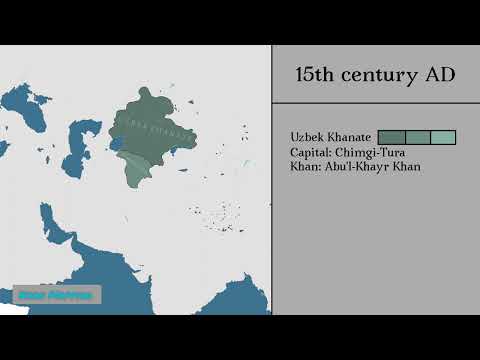
Muhammad Shaybani, a grandson of the steppe ruler Abu'l-Khayr Khan, claimed descent from Genghis Khan through his son Jochi. Between 1500 and 1503 he led his Uzbeks into Transoxiana and took Samarkand, Bukhara, Tashkent and Andijan from the Timurids. He beat the Timurid prince Babur at Sar-i Pul in the spring of 1501, and in 1505 he took Urgench after a ten-month siege. In 1510 the Safavid Shah Ismail I, enraged by his strict Sunnism, defeated and killed him outside Merv.
His family, the Shaybanids, divided the land into appanages centred on Bukhara, Samarkand, Tashkent and Balkh, and for most of the century the khanate had no fixed capital. Its khans were men of letters: Shaybani wrote poetry in Turkic and Persian, and his nephew Ubaydullah Khan wrote verse in Turkic, Persian and Arabic. Abdullah Khan II, who held real power from 1561 and ruled as khan until 1598, centralised the state and made Bukhara its permanent capital.
In 1599 the Janids, a family that had fled Astrakhan when the Russians took it, came to power, the last descendants of Genghis Khan to rule Bukhara. After the Janid khan Ubaydullah II was murdered in 1711 the state broke into principalities. Nader Shah of Iran conquered it in 1740, and in 1785 the Manghit Shah Murad turned it into the Emirate of Bukhara.
Read more on Wikipedia