Industrial age · person
Katsushika Hokusai
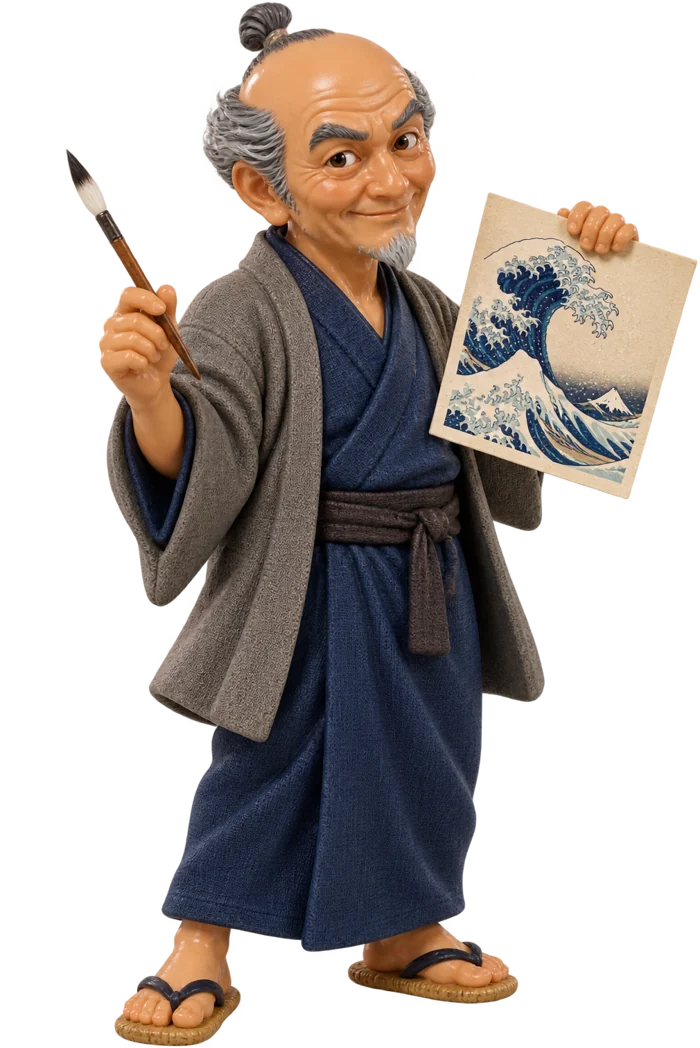
Around the age of 70, an Edo printmaker who claimed nothing he had drawn before was worth much designed a giant wave curling over the boats, with Mount Fuji tiny behind it.
Hokusai was born, probably on 31 October 1760, in the Honjo district of Edo on the east bank of the Sumida River, and began painting at about six, perhaps taught by his father, who painted designs around mirrors. At 14 he was apprenticed to a woodcarver, and at 18 he entered the studio of Katsukawa Shunshō, a master of ukiyo-e prints of courtesans and kabuki actors. Shunshō named him Shunrō, the first of at least thirty names he used, and in 1779 he published his first prints.
He grew famous partly through showmanship: at an Edo festival in 1804 he painted the Buddhist monk Daruma about 200 square metres in size, using a broom and buckets of ink. From 1812 he published drawing manuals, and his sketchbooks, the Hokusai Manga, filled thousands of pages with plants, animals and everyday people. In the early 1830s he produced Thirty-six Views of Mount Fuji for a boom in domestic travel, and its prints The Great Wave off Kanagawa and Fine Wind, Clear Morning made him famous in Japan and overseas.
From 1834 he signed himself "The Old Man Mad About Art" and made One Hundred Views of Mount Fuji. He kept working almost to the end, painting Tiger in the Snow early in 1849, and on his deathbed is said to have begged Heaven for five more years. He died on 10 May 1849, aged 88, after more than 30,000 paintings, sketches, prints and book pictures. His work later inspired Van Gogh and Monet.
Read more on Wikipedia
Sources: en.wikipedia.org/wiki/Hokusai


