Middle Ages · state
Karakhanid Khanate
Among the first Turkic dynasties to embrace Islam, it took Central Asia from the Persians, and one of its sons wrote the first great dictionary of the Turkic languages.
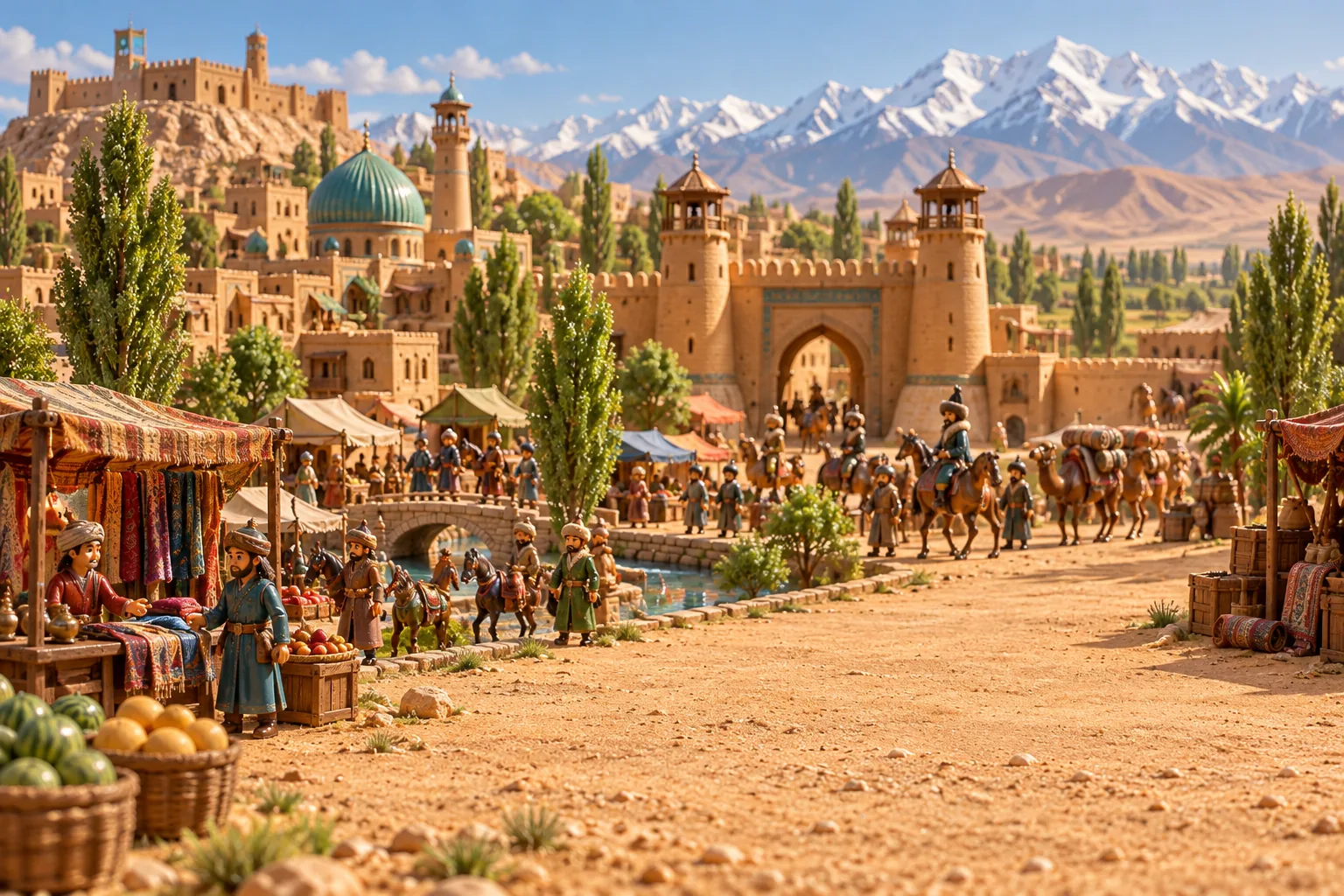
The Karakhanids grew out of a confederation of Karluks, Yagmas, Chigils and other Turkic peoples living in today's Kyrgyzstan and around Kashgar in the 9th century. Their rulers took the old title Qara Khagan. The eastern khagan was called Arslan, lion, and the western one Bughra, male camel, after the totems of their tribes.
In 934 the khagan Satuq Bughra converted to Islam and captured Kashgar, and in the mid-10th century the dynasty took Muslim names. His grandson Hasan Bughra Khan briefly took Bukhara from the Persian Samanids, and by 999 his cousin's son Nasr held Samarkand and Bukhara, ending Samanid rule in Transoxiana. Their arrival marked a lasting shift from Iranian to Turkic power in Central Asia, though the khans took up Persian and Arab Muslim culture. They also fought a long war against the Buddhist kingdom of Khotan.
In the 1040s the khanate split into an eastern state around Kashgar and Balasagun and a western one centred on Samarkand. Ibrahim Tamghach Khan founded the first madrasa in Central Asia at Samarkand, and a hospital. The Seljuks made the khans their vassals, then the Qara Khitai after their victory at Qatwan in 1141. The eastern line ended in 1211, and the Khwarazm Shah destroyed the western one in 1212.
Read more on Wikipedia
Sources: en.wikipedia.org/wiki/Kara-Khanid Khanate, en.wikipedia.org/wiki/Mahmud al-Kashgari, en.wikipedia.org/wiki/Burana Tower


