Middle Ages · state
Kannauj under Yashovarman
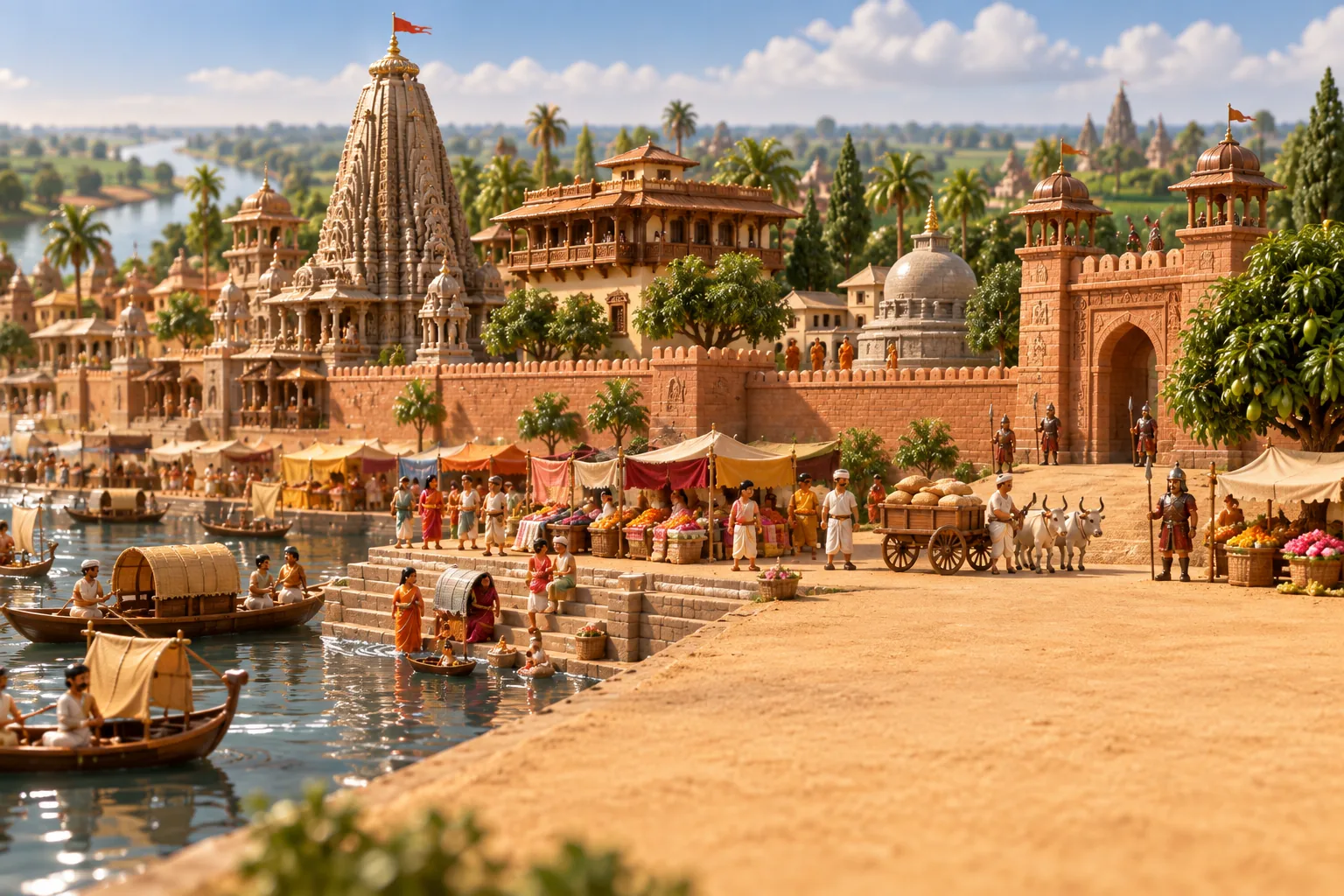
Harsha's old capital on the Ganges rose again under an 8th-century king, and after him it was such a prize that three great dynasties fought over it.
Kannauj, the ancient Kanyakubja, appears in the Mahabharata and Ramayana. In the 6th century the Maukhari kings ruled northern India from it, and under Emperor Harsha, from 606 to 647, it became the greatest city of the north. The Chinese pilgrim Xuanzang found it large and prosperous, with many Buddhist monasteries. Harsha died without an heir, and for decades no strong ruler held the city.
In the early 8th century Yashovarman, first king of the Varman dynasty, took power there. Historians date his reign roughly to 725–752. His court poet Vakpati wrote the Prakrit poem Gaudavaho, the Slaying of the King of Gauda, which credits him with conquests from Bengal to Kashmir; historians read it more as praise than as history. In 731 Yashovarman sent a minister to the Tang court in China, and for a time he was allied with Lalitaditya Muktapida of Kashmir against the Tibetans, until the alliance broke down around 740; Kashmiri chronicles say Lalitaditya then defeated him.
According to Jain chronicles his son Āma followed him. Later in the century the Gurjara-Pratiharas, the Palas of Bengal and the Rashtrakutas of the Deccan fought the Tripartite Struggle for Kannauj, and in the 9th century Nagabhata II made it the Pratihara capital.
Read more on Wikipedia
Sources: en.wikipedia.org/wiki/Kannauj, en.wikipedia.org/wiki/Yashovarman