Early modern · state
Joseon
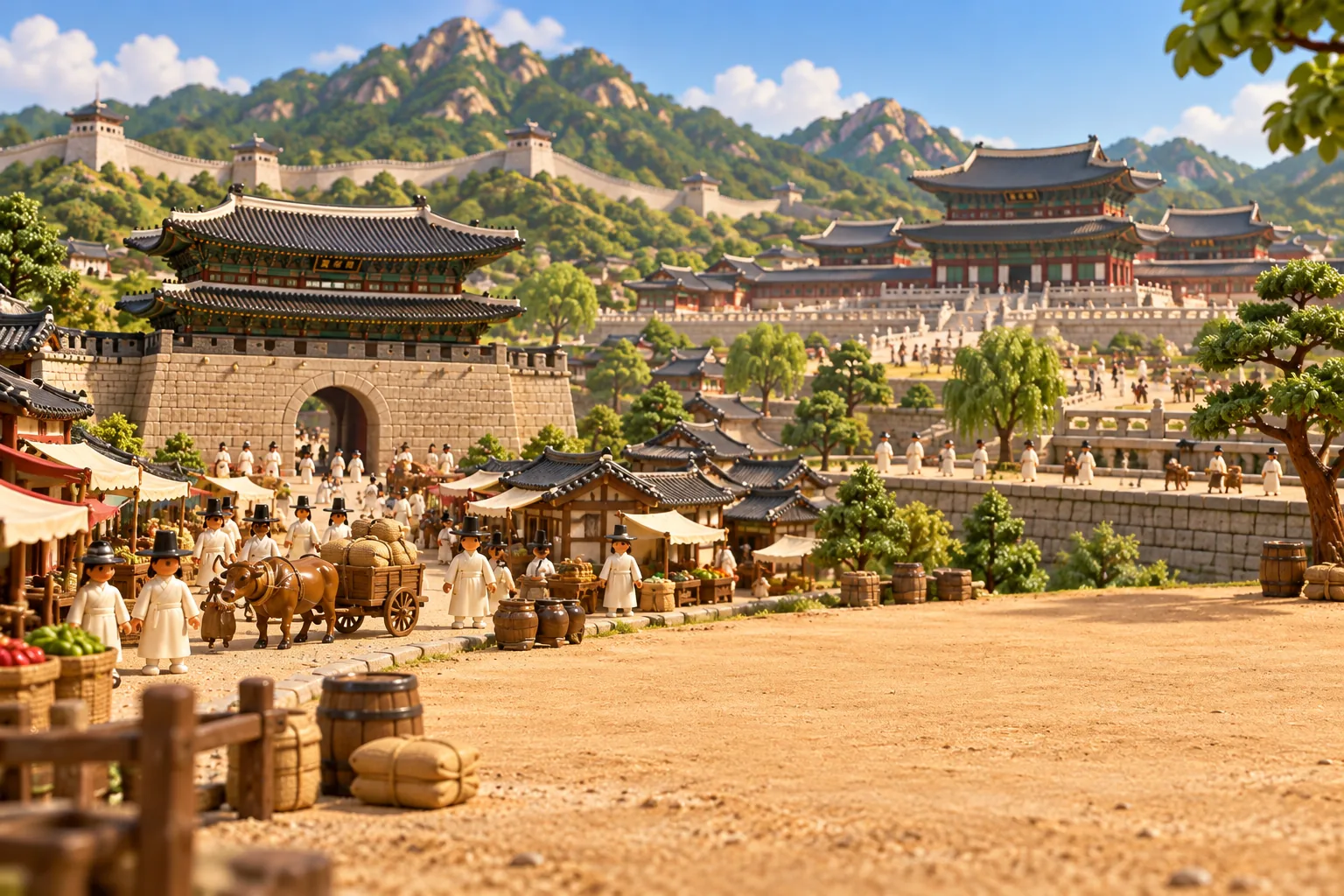
Joseon ruled Korea for 505 years, and in 1443 its King Sejong gave Koreans an alphabet of their own, Hangul.
By the late 14th century the Goryeo kingdom was collapsing. In 1388 General Yi Seong-gye, sent to attack the Ming-held Liaodong peninsula, turned his army round and seized the capital, Kaegyong. In 1392 he took the throne himself as King Taejo, named the kingdom Joseon after ancient Gojoseon and moved the capital to Hanseong, today's Seoul. Neo-Confucianism became the state ideology, and Buddhism was discouraged.
Sejong the Great, king from 1418, sent an expedition against the pirates of Tsushima, built forts against the Jurchens that pushed the border to roughly today's line with China, and in 1443 created Hangul, the Korean alphabet. Under him the low-born engineer Jang Yeong-sil built a self-striking water clock in 1434. In 1592 the Japanese ruler Toyotomi Hideyoshi invaded, and Hanseong and Pyongyang fell within months, but Admiral Yi Sun-sin destroyed the Japanese fleet, turtle ships were built, and Ming troops came to help.
Manchu invasions in 1627 and 1636 forced King Injo to accept the Qing as overlords. Nearly 200 years of peace followed, and Joseon closed itself off so firmly that Westerners called it the hermit kingdom. In 1876 Japan forced it to open three ports. After the Donghak Peasant Revolution of 1894 and the Sino-Japanese War, Japanese agents murdered Queen Min in 1895, and in 1897 King Gojong proclaimed the Korean Empire.
Read more on Wikipedia
Sources: en.wikipedia.org/wiki/Joseon


