
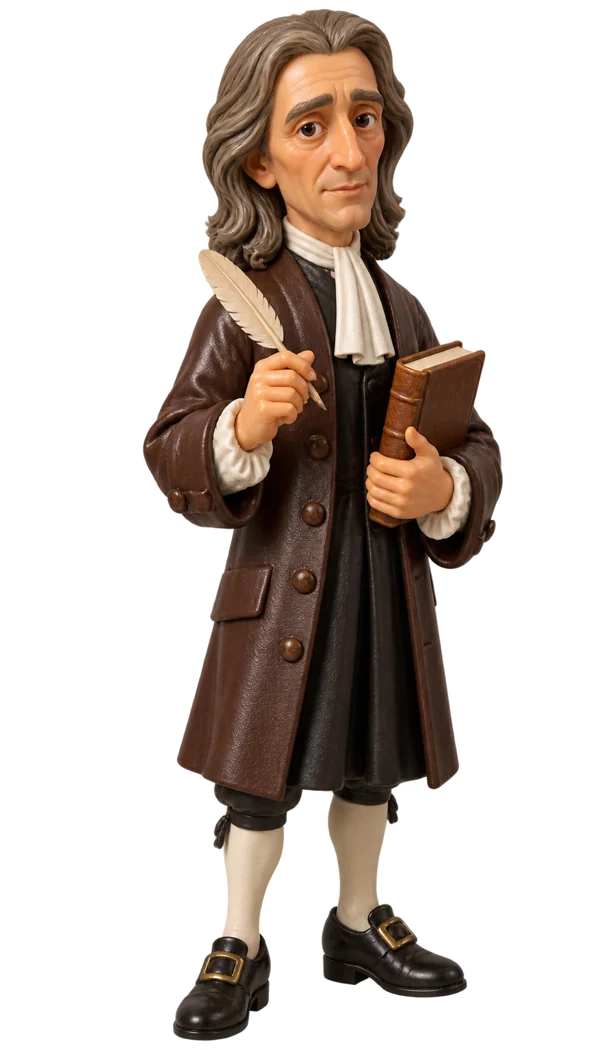
Early modern · person
John Locke
Back from five years of exile, he published the book that said governments rule only by the consent of the people, but he put his name only on his essay about the mind.
John Locke was born on 29 August 1632 in Wrington, Somerset, to Puritan parents; his father fought for Parliament in the Civil War. He studied at Westminster School and from 1652 at Christ Church, Oxford, where he worked alongside the scientists Robert Boyle and Robert Hooke and studied medicine. In 1666 a chance errand brought him to Anthony Ashley Cooper, later Earl of Shaftesbury, who made him his doctor and adviser; when a liver infection grew life-threatening, Shaftesbury credited Locke with saving his life.
He moved into Shaftesbury's London house and followed him into politics, drafting the Fundamental Constitutions of Carolina as his secretary. In 1683, with the crown hostile to Shaftesbury's circle, he slipped away to the Dutch Republic. Five years in exile were the most productive of his life. After William of Orange took the throne in the Glorious Revolution, Locke sailed home with Princess Mary's party. In quick succession he published An Essay Concerning Human Understanding, which argued that the mind starts as a blank slate, A Letter Concerning Toleration and Two Treatises of Government, which held that power comes from the consent of the governed.
He spent his last years at Oates Manor in Essex with his friend, the philosopher Lady Damaris Masham, and died there on 28 October 1704. A phrase from the Second Treatise, "a long train of abuses", appears word for word in the American Declaration of Independence.
Read more on Wikipedia
Sources: en.wikipedia.org/wiki/John Locke


