Early modern · person
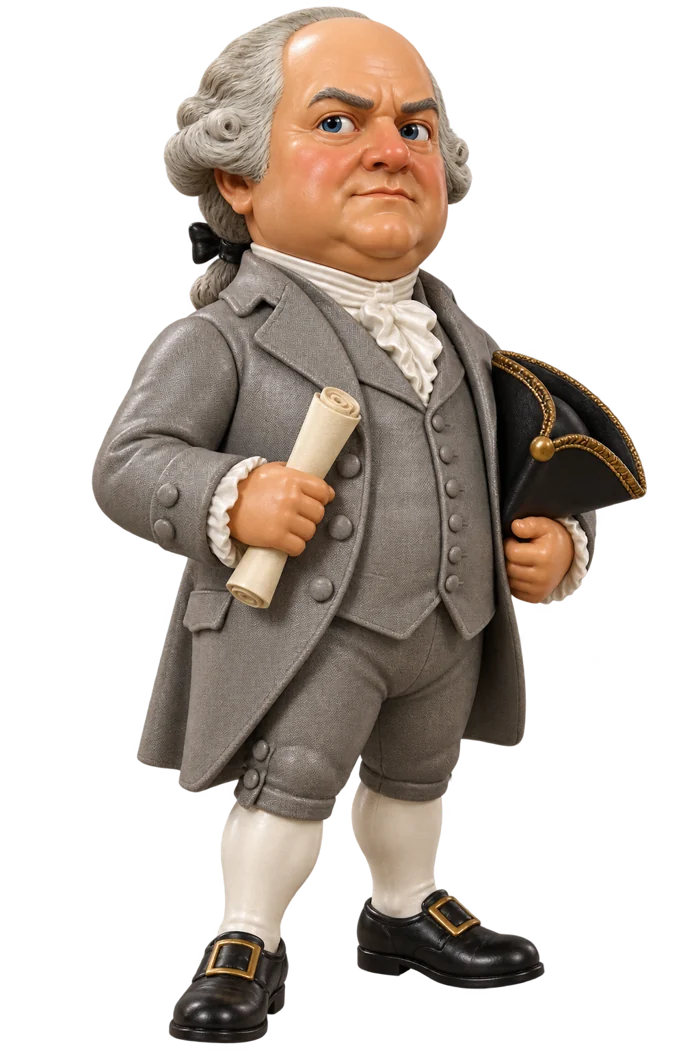
John Adams
When no other lawyer in Boston would defend the British soldiers of the Boston Massacre, he took the case, and 27 years later he became the second president of the United States.
John Adams was born on 30 October 1735 on his family's farm in Braintree, Massachusetts, the son of a farmer, shoemaker and church deacon. He entered Harvard at 16, taught school, read law in Worcester and was admitted to the bar in 1759. In 1764 he married Abigail Smith, his third cousin, who shared his love of books; their son John Quincy became the sixth president. He rose to prominence attacking the Stamp Act in 1765, yet in 1770 he defended the British soldiers accused of murder after the Boston Massacre, insisting that "facts are stubborn things", and won acquittals for six of the eight.
In the Continental Congress he nominated George Washington to command the army in 1775, sat on ninety committees and pushed hardest for independence. He chose the Committee of Five that drafted the Declaration, with Thomas Jefferson as its writer. As a diplomat he won a Dutch loan, helped negotiate the 1783 Treaty of Paris and in 1785 became the first American ambassador to George III. He served two terms as Washington's vice president, "the most insignificant office", he complained, and was sworn in as president on 4 March 1797.
His term brought the undeclared naval Quasi-War with France and the Alien and Sedition Acts. He was the first president to live in the White House, but lost the 1800 election to Jefferson. They later made up by letter, and both died on 4 July 1826, the 50th anniversary of the Declaration.
Read more on Wikipedia
Sources: en.wikipedia.org/wiki/John Adams


