
Middle Ages · person
Johannes Gutenberg
In a Mainz workshop around 1455, metal letters cast one by one printed about 180 copies of the Bible, and the age of the hand-copied book began to end.
Johannes Gensfleisch zur Laden zum Gutenberg was born in Mainz, a wealthy city on the Rhine; his birth year is unknown, and 1400 is assigned "for the sake of convenience". He took his name from the Hof zum Gutenberg, a Gothic house his father, a patrician, had inherited. Around 1439 he lost money on a scheme to sell polished metal mirrors to pilgrims at Aachen, when a flood delayed the city's display of relics by a year.
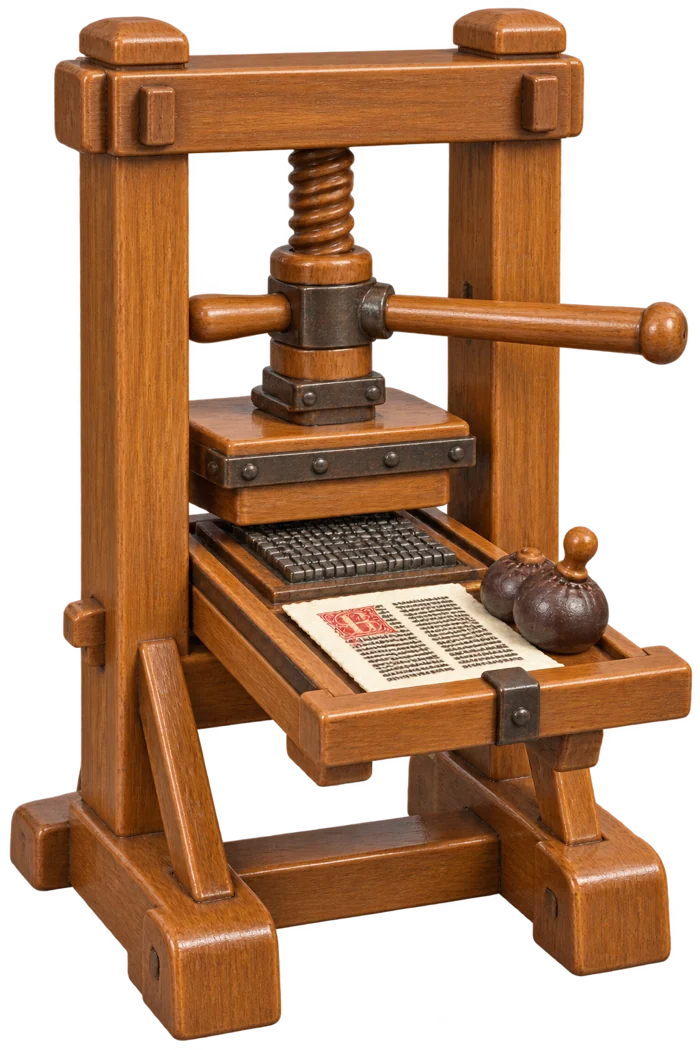
He lived in Strasbourg until at least 1444, and there in 1440 he is said to have perfected a secret he called "enterprise and art". Back in Mainz by 1448, he had a press working by 1450 and borrowed 800 guilders from the moneylender Johann Fust, then 800 more for a Bible, begun in 1452. His inventions included a hand mould for casting type from an alloy of lead, tin and antimony, oil-based ink and a wooden press like the farm screw presses. In 1455 he finished the 42-line Bible: about 180 copies, three quarters on paper and the rest on vellum.
Fust then sued him, and the archbishop's court gave Fust control of the Bible workshop. Gutenberg was bankrupt, though he may have supplied type for a Bible printed at Bamberg around 1459. On 18 January 1465 Archbishop Adolph von Nassau made him a gentleman of the court, with a stipend, a yearly court outfit and tax-free grain and wine. He died in 1468, and his grave is now lost. His press spread across Europe and fed the Renaissance and the Reformation.
Read more on Wikipedia


