
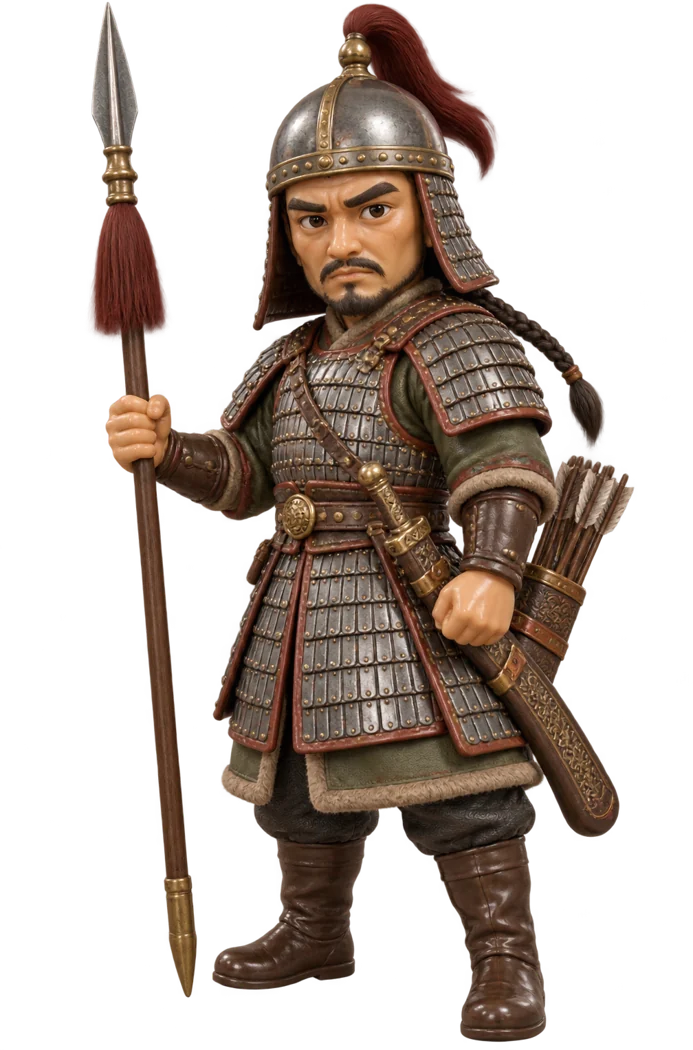
Middle Ages · state
Jin dynasty (1115–1234)
Jurchen horsemen captured the Song capital Kaifeng and two Song emperors in 1127, then fell to the Mongols a century later.
The Jurchens of Manchuria were subjects of the Khitan Liao dynasty until 1115, when Wanyan Aguda rebelled and proclaimed a new dynasty. He named it Jin, gold, after the Jurchen word alchun. For a while allied with the Song, the Jurchens drove the Liao out of northern China by 1125 and then turned on the Song themselves.
On 9 January 1127 Jin troops broke into the Song capital Kaifeng and carried off the emperors Huizong and Qinzong with a host of courtiers, an event remembered as the Jingkang Incident. The Song court fled south, and the Treaty of Shaoxing made the Huai River the border, with a yearly tribute of silver and silk paid to the Jin. In 1152 the emperor Wanyan Liang moved his residence to Yanjing, today's Beijing, and renamed it the Central Capital, Zhongdu. Under Emperor Shizong Chinese classics were translated into Jurchen, and the state examinations were offered in the Jurchen language.
In the spring of 1211 the Mongols of Genghis Khan attacked in two directions and won battle after battle. Zhongdu fell on 31 May 1215, and the Jin court moved south to Kaifeng. Caught between the Mongols and the Song, the dynasty held out for almost twenty more years until the Mongols finally conquered it in 1234.
Read more on Wikipedia
Sources: en.wikipedia.org/wiki/Jin dynasty (1115–1234), en.wikipedia.org/wiki/Jin dynasty (1115–1234)


