Early modern · person
James Cook
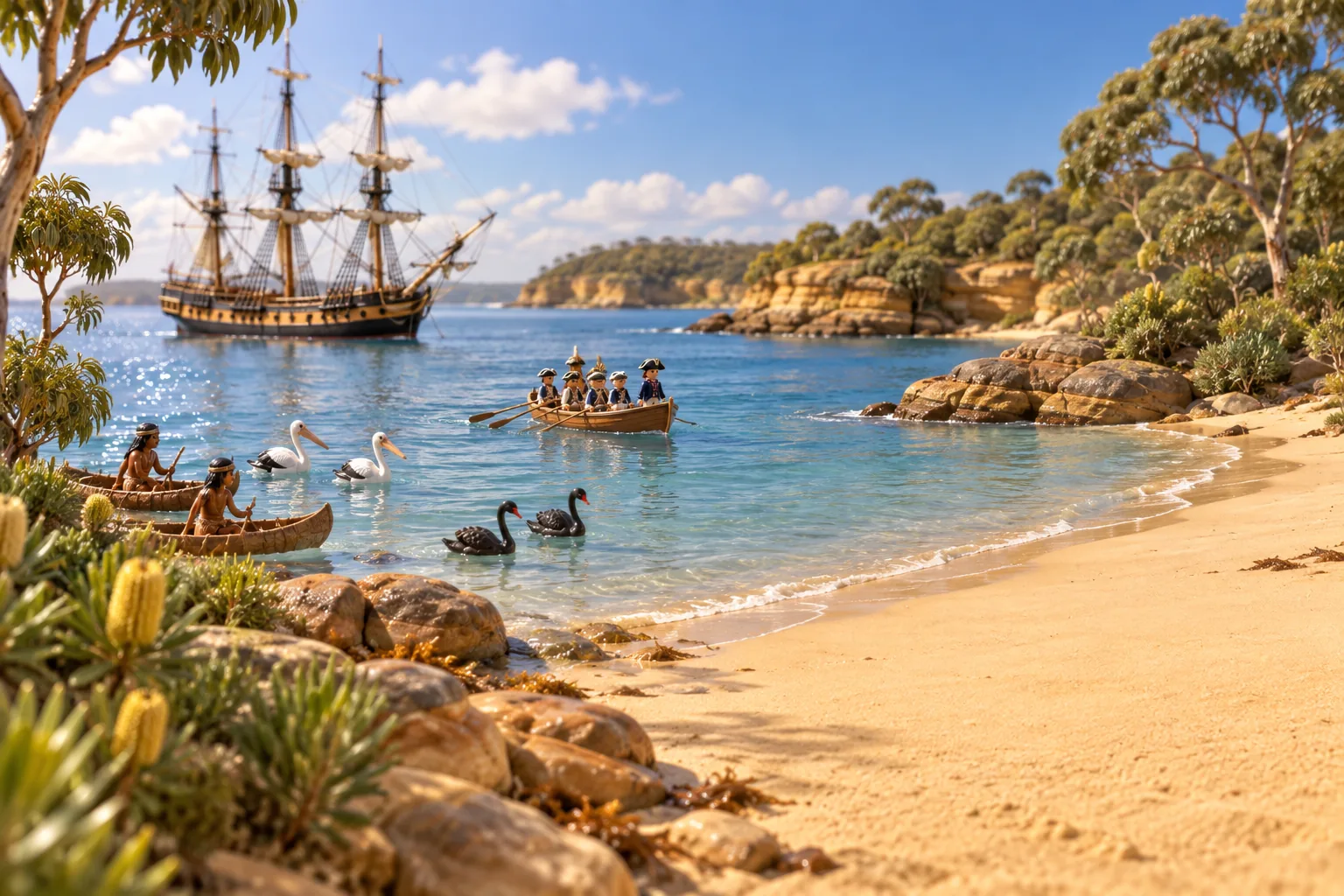
On 29 April 1770 a converted coal ship from Whitby anchored in a bay full of strange plants, and Europe met the east coast of Australia.
James Cook was born on 7 November 1728 in Marton, Yorkshire, the son of a Scottish farm labourer. At 16 he was apprenticed to a grocer in the fishing village of Staithes, but he was not suited to shop work, and at Whitby the shipowners John and Henry Walker took him on as an apprentice in their coal ships. He joined the Royal Navy in 1755, fought at the Siege of Louisbourg in the Seven Years' War. His maps of Newfoundland and his record of a solar eclipse on 5 August 1766 brought him to the attention of the Royal Society.
In 1768 he was given HMS Endeavour, a former collier, to observe the transit of Venus from Tahiti with the young naturalist Joseph Banks aboard. With the help of the Tahitian priest Tupaia he spoke with the Māori and charted both main islands of New Zealand. On 29 April 1770 he made his first landfall in Australia at Botany Bay, where two Gweagal men opposed the landing. Sailing north, Endeavour ran aground on the Great Barrier Reef on 11 June, was repaired for seven weeks at the Endeavour River, and at Possession Island Cook claimed the coast for Britain.
On his second voyage, in Resolution, his crews became on 17 January 1773 the first recorded Europeans to cross the Antarctic Circle. On the third he reached Hawaii, which he named the Sandwich Islands. Forced back to Kealakekua Bay by a broken mast, he was killed there in a clash with Hawaiians on 14 February 1779.
Read more on Wikipedia
Sources: en.wikipedia.org/wiki/James Cook

