Early modern · state
Jagiellonian dynasty
A pagan grand duke was baptised to marry Poland's queen, and around 1500 his grandsons sat on the thrones of Poland, Lithuania, Bohemia and Hungary.
Jogaila, Grand Duke of Lithuania, was baptised as Władysław in 1386 and married Jadwiga, the young queen regnant of Poland, becoming King Władysław II Jagiełło. The personal union of Poland and Lithuania began the long partnership of the two countries. In 1410 their joint armies crushed the Teutonic Knights at Grunwald. His son Władysław III was also elected King of Hungary in 1440 and fell fighting the Ottomans at Varna in 1444.
Władysław's brother Casimir IV ruled both Poland and Lithuania. Casimir's son Vladislaus became King of Bohemia in 1471 and of Hungary in 1490, so that around 1500 the brothers held four crowns from the Baltic to the Adriatic. The dynasty's power in the south ended on 29 August 1526, when Vladislaus's son Louis II lost the Battle of Mohács to Suleiman the Magnificent and died. Bohemia and Hungary passed to the Habsburgs.
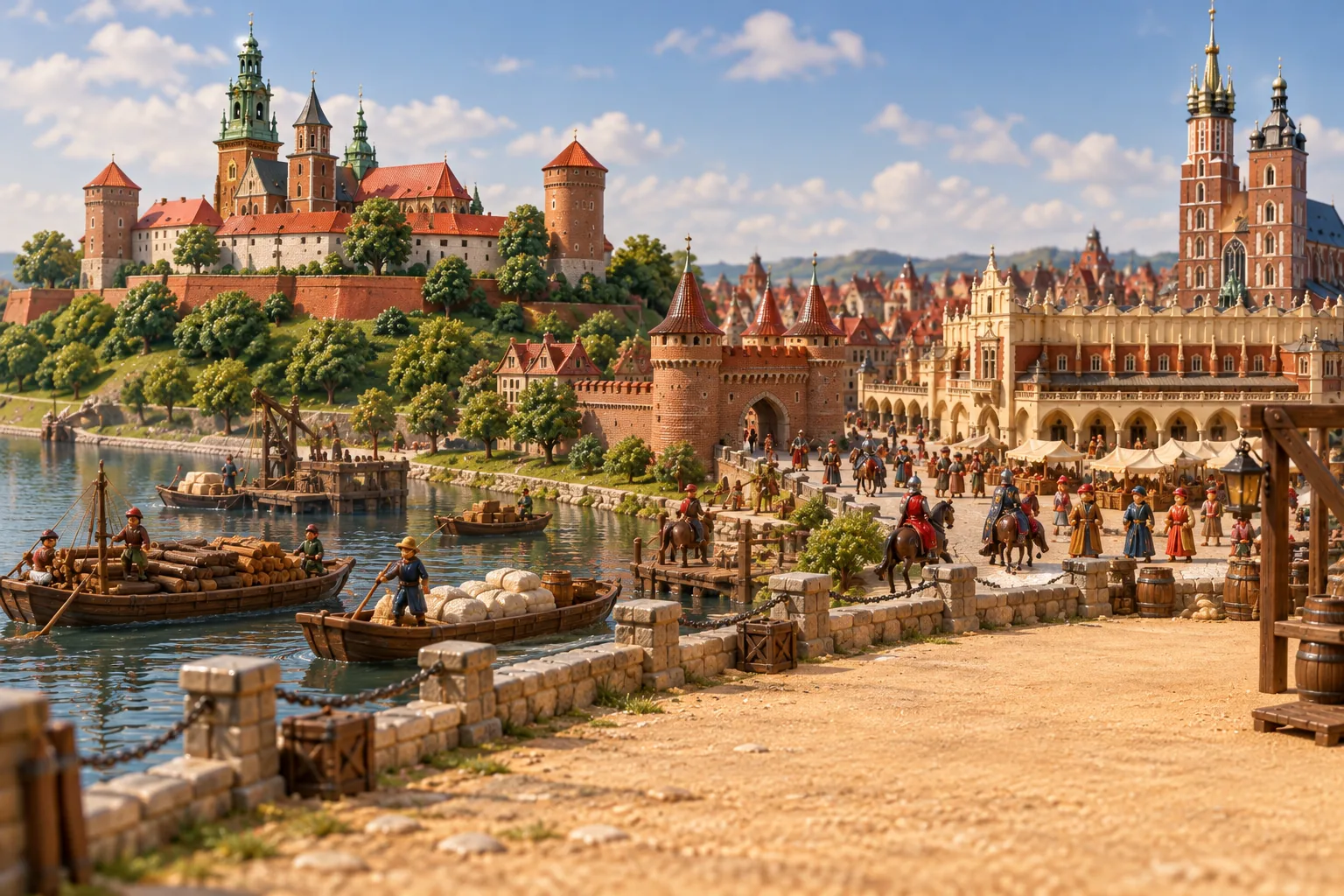
In Poland the reigns of Sigismund I and his son Sigismund II Augustus became the golden age of the Polish Renaissance, centred on Kraków. In 1569 the Union of Lublin turned the two countries into the Polish–Lithuanian Commonwealth. Sigismund II died in 1572 without a son, and the male line of the Jagiellons ended.
Read more on Wikipedia
Sources: en.wikipedia.org/wiki/Jagiellonian dynasty, en.wikipedia.org/wiki/Battle of Mohács