
Industrial age · person
Jagadish Chandra Bose
In November 1895 a Calcutta physics professor sent invisible waves through two walls and through the body of the Lieutenant Governor to ring a bell 23 metres away.
Jagadish Chandra Bose was born on 30 November 1858 in Mymensingh, in Bengal, now part of Bangladesh. His father, a civil servant and a leading member of the Brahmo Samaj, sent him first to a Bengali-language school, where his classmates were the sons of a fisherman and of his father's Muslim attendant. He studied at St Xavier's College in Calcutta, gave up medical studies in London through ill health, then read natural sciences at Christ's College, Cambridge, where Lord Rayleigh was among his teachers.
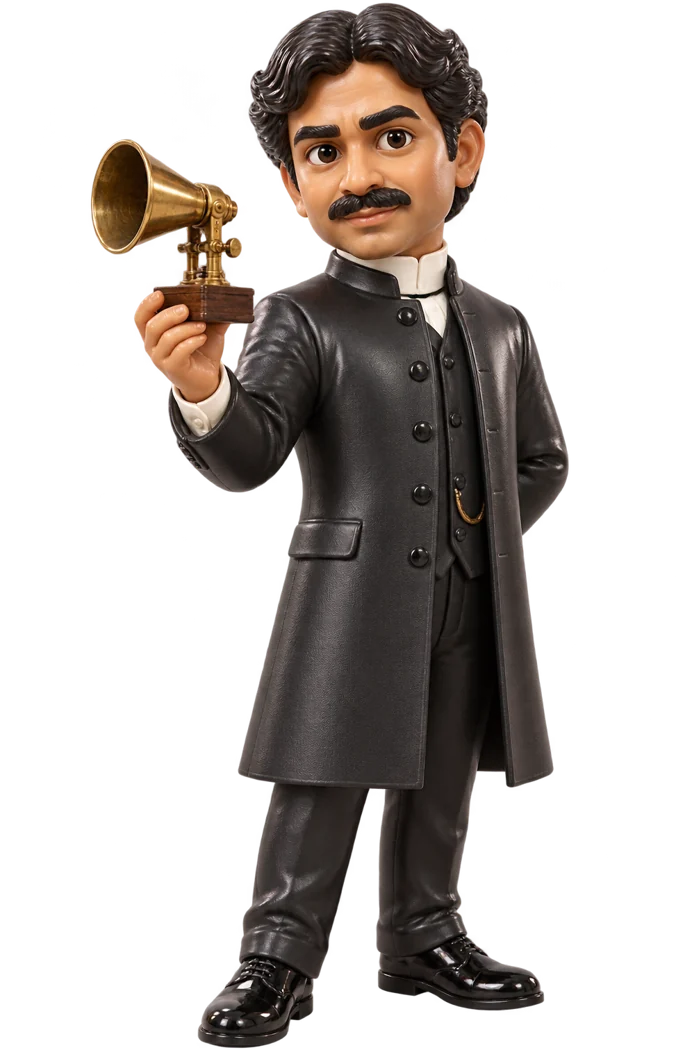
In January 1885 he became a professor of physics at Presidency College, Calcutta. Offered a third of a European professor's pay, he refused any salary for three years. From November 1894, in a small room at the college, he worked with radio waves only about 5 millimetres long. In November 1895, at Calcutta's Town Hall, he sent them through two walls and through Sir William Mackenzie to ring a bell 23 metres away. He was the first to use a semiconductor crystal to detect radio waves, and built horn antennas and waveguides.
Later he turned to plants, building the crescograph and other recorders to show that they answer stimuli with electrical signals, and wrote Response in the Living and Non-Living in 1902. On 30 November 1917 he opened the Bose Institute in Calcutta, which he directed until his death. He was knighted in 1917 and made a Fellow of the Royal Society in 1920. He died on 23 November 1937, and in 2012 his millimetre-wave work became an IEEE Milestone.
Read more on Wikipedia
Sources: en.wikipedia.org/wiki/Jagadish Chandra Bose, en.wikipedia.org/wiki/Bose Institute


