
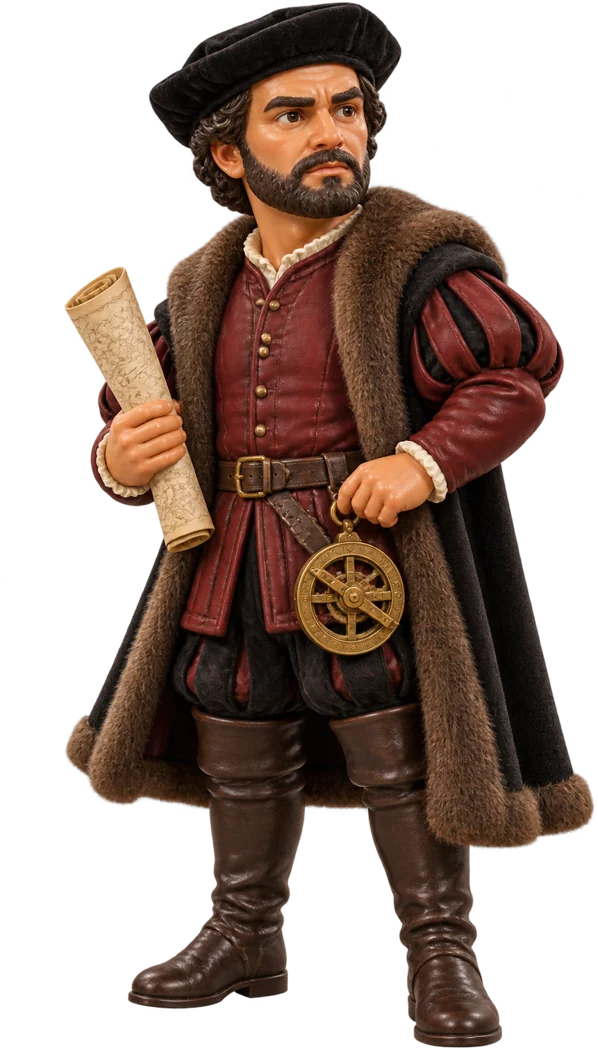
Early modern · person
Jacques Cartier
Looking for a sea route to China, he sailed up a great river in 1535 and heard the Iroquoian word for village, kanata, and that is how a whole country got its name.
Jacques Cartier was born in 1491 in Saint-Malo, the port on the north coast of Brittany. In 1520 he married Mary Catherine des Granches, of a leading local family. In 1534 Jean Le Veneur, bishop of Saint-Malo, introduced him to King Francis I, pointing to his voyages to Newfoundland and Brazil. On 20 April 1534 Cartier sailed under the king's commission to look for a western passage to Asia and for lands rich in gold.
That summer he explored the coasts of Newfoundland, Labrador and the Gulf of St. Lawrence, and on 24 July at Gaspé Bay he planted a ten-metre cross claiming the land for France. He carried two sons of the Iroquoian chief Donnacona back to France. On 19 May 1535 he returned with three ships and 110 men, sailed up the St. Lawrence to Donnacona's town of Stadacona and on 2 October reached Hochelaga, where rapids stopped him. That winter his ships lay frozen under the Rock of Quebec and scurvy struck; Domagaya showed the French a cure made from a tree called annedda, and 85 of them survived. In May 1536 Cartier took Donnacona himself to France.
His third voyage, in 1541, founded the fort of Charlesbourg-Royal at today's Cap-Rouge, but the "diamonds" and gold his men collected turned out to be quartz and pyrite, and he sailed home in 1542. He spent the rest of his life in Saint-Malo and died there on 1 September 1557, aged 65. He is buried in Saint-Malo Cathedral.
Read more on Wikipedia
Sources: en.wikipedia.org/wiki/Jacques Cartier, en.wikipedia.org/wiki/Stadacona

