Middle Ages · state
Isle of Man
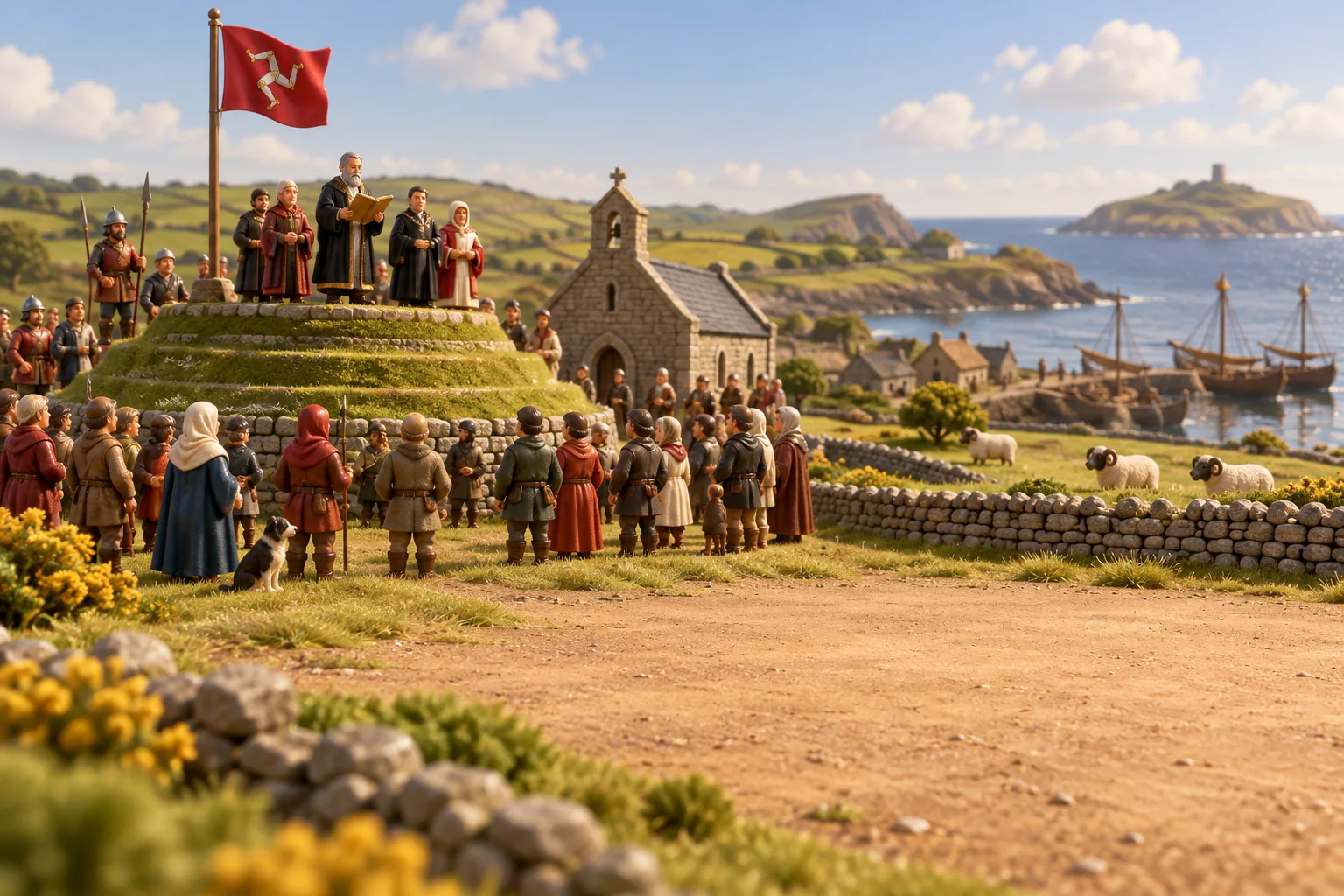
A small island in the Irish Sea has kept its own Norse-founded parliament for a thousand years and was never part of the United Kingdom.
People have lived on Man since before 6500 BC, and by the 5th century AD it was Gaelic in speech and Christian in faith. Vikings raided from the late 8th century and then settled. Around 914 Norse-Gaelic kings took over, and the island became the heart of the Kingdom of Mann and the Isles, with its capital on St Patrick's Isle at Peel. From 1079 it was held by the dynasty of Godred Crovan. These Norse rulers founded Tynwald, the island's parliament.
In the Treaty of Perth of 1266 Magnus VI of Norway handed Man to Alexander III of Scotland, and a Manx revolt was crushed at Ronaldsway in 1275. Edward I of England sent his men in 1290, Robert the Bruce took it back in 1313 after a five-week siege of Castle Rushen, and control swung back and forth until the English took it for the last time in 1346. The English Crown then granted the island to a series of Lords of Mann, while Tynwald kept passing its laws.
In 1765 the Act of Revestment bought the lordship from the Dukes of Atholl for the Crown. The island won limited home rule in 1866 with elections to the House of Keys. It is a Crown Dependency: the UK handles its defence and foreign affairs, but Man is not part of the UK and never joined the European Union.
Read more on Wikipedia
Sources: en.wikipedia.org/wiki/Isle of Man, en.wikipedia.org/wiki/Tynwald