Early modern · person
Isaac Newton
A Cambridge professor who said the problem made his head ache wrote a book that explained, with one law, why apples fall and planets go round the Sun.
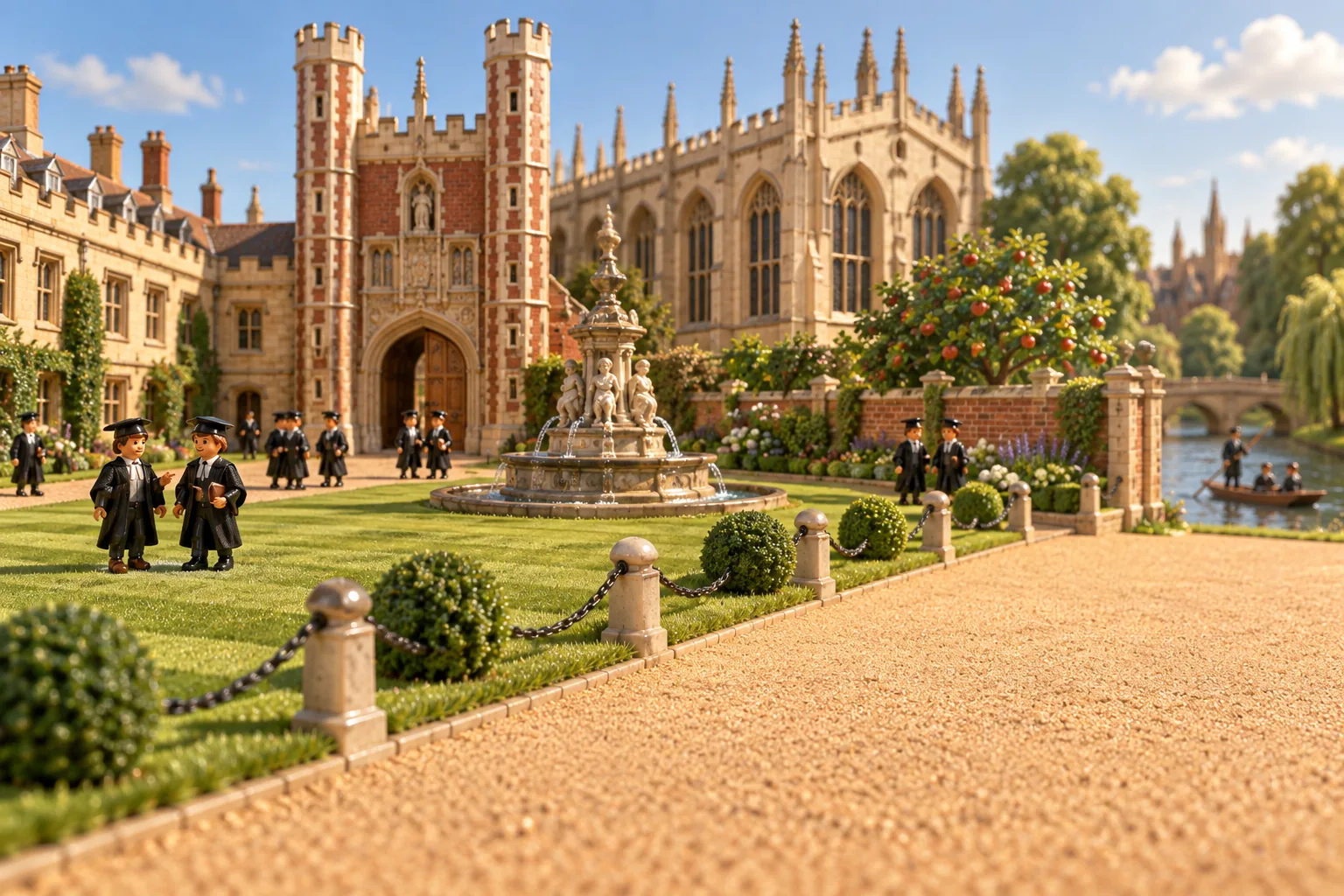
Isaac Newton was born at Woolsthorpe Manor in Lincolnshire on Christmas Day 1642 by the old calendar, 4 January 1643 by ours. In 1661 he went up to Trinity College, Cambridge. When the university closed against the Great Plague in 1665 he went home to Woolsthorpe, and in the next two years worked out the beginnings of calculus, his ideas on light and the law of gravitation. In 1669, aged 26, he became Lucasian Professor of Mathematics at Cambridge.
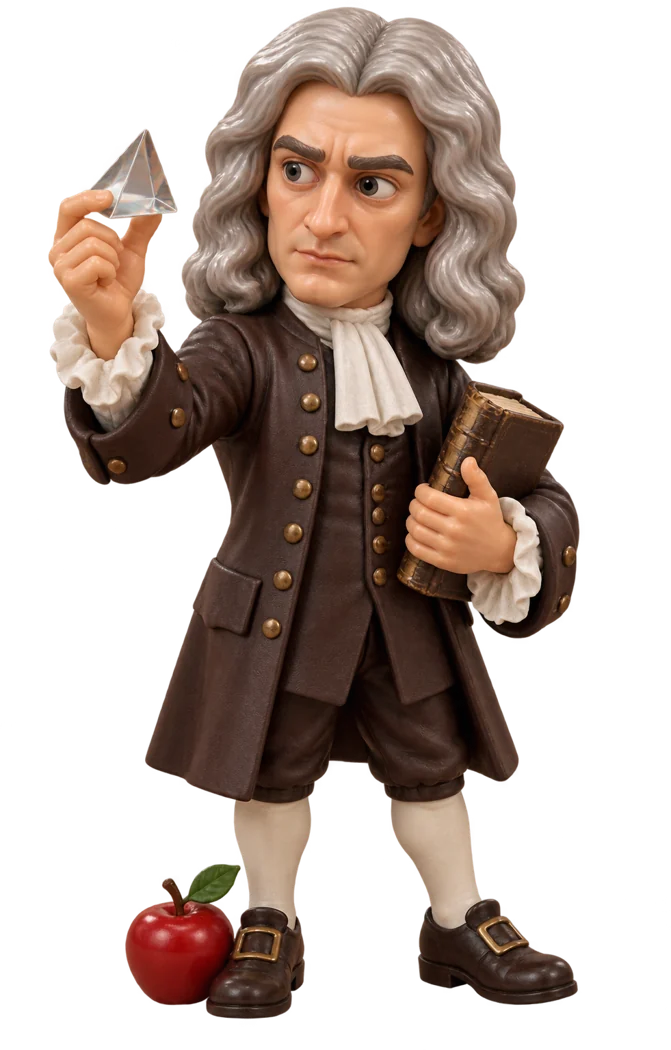
He showed that a prism splits white light into the colours of the spectrum and built the first reflecting telescope. Letters with Robert Hooke in 1679–80 pushed him to prove that a force falling with the square of the distance makes planets move in ellipses. Edmond Halley urged him to publish, and on 5 July 1687 the Philosophiæ Naturalis Principia Mathematica appeared, printed with Halley's encouragement and money. Its three laws of motion and its law of universal gravitation ruled physics until Einstein's relativity.
In 1696 Newton moved to London as Warden of the Royal Mint, then Master from 1699, and hunted down counterfeiters. He was president of the Royal Society from 1703, was knighted by Queen Anne in 1705, and fought a bitter quarrel with Gottfried Wilhelm Leibniz over who invented calculus. He never married. He died on 31 March 1727, aged 84, and was the first scientist to be buried in Westminster Abbey.
Read more on Wikipedia
Sources: en.wikipedia.org/wiki/Isaac Newton, en.wikipedia.org/wiki/Philosophiæ Naturalis Principia Mathematica


