Antiquity · state
Indo-Greek Kingdoms
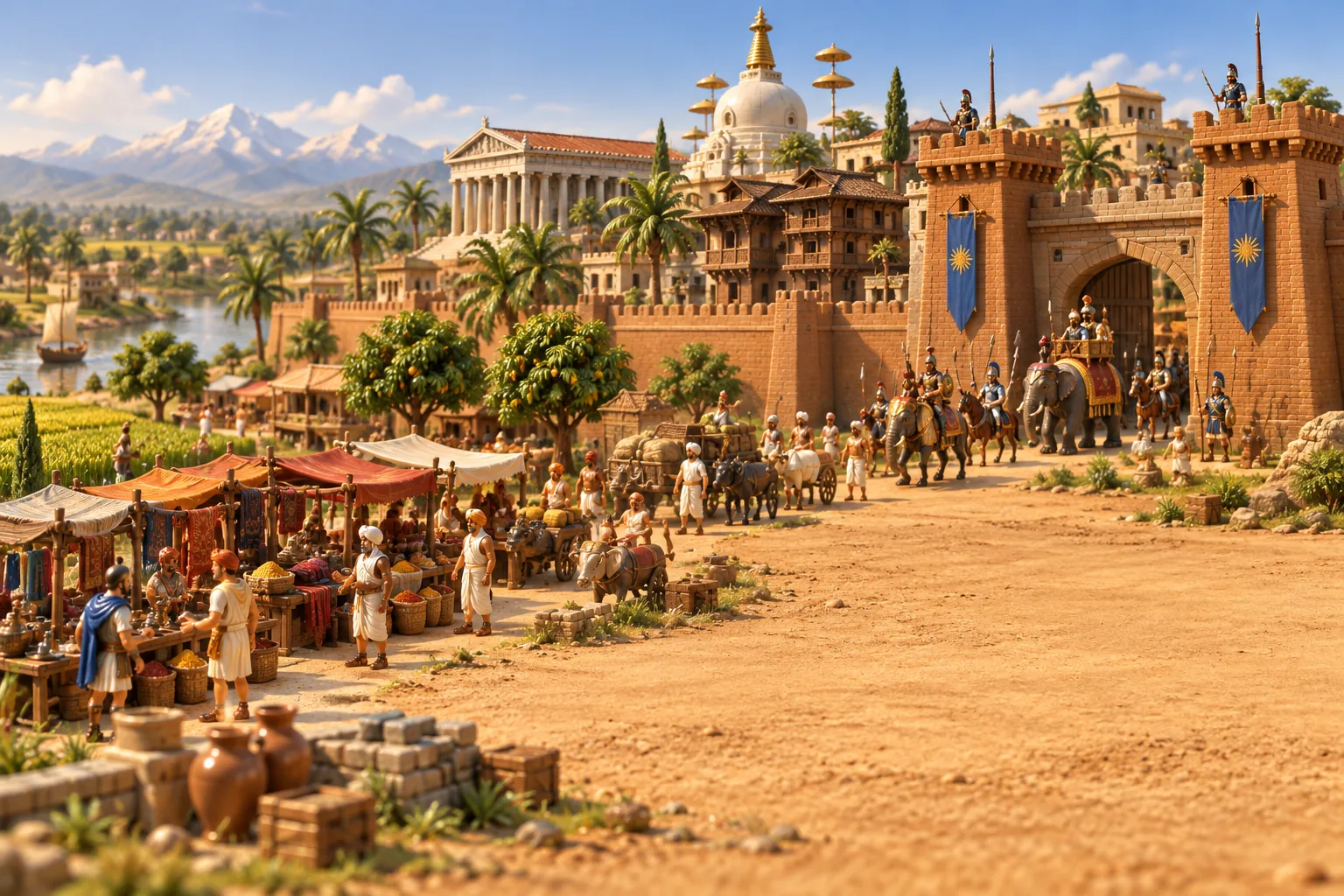
Greek kings ruled Afghanistan and Punjab for two centuries, and one of them, Menander, appears in a Buddhist book questioning a monk.
Alexander the Great reached the north-west of India in 326 BC, and Greeks, called Yavanas in Indian sources, stayed on under the Maurya emperors. Around 200 BC Demetrius I of Bactria invaded from Bactria and seems to have taken the Kabul valley and Arachosia, and on his coins he always wears a helmet made from an elephant's scalp. From about 180 BC Apollodotus I ruled Gandhara and western Punjab as the first king based in India rather than in Bactria.
The greatest of these kings, Menander I, ruled from about 165 BC until his death in 130 BC, with his capital at Sagala, today's Sialkot. He led an expedition as far as Mathura, and his coins are found in larger numbers and over a wider area than those of any other Indo-Greek king. The kings struck bilingual coins, with Greek on one side and an Indian language in Kharoshthi script on the other. In the Buddhist Milinda Panha, Menander, called Milinda, questions the sage Nagasena.
After Menander his realm splintered into several kingdoms, among them that of Queen Agathokleia and her son Strato I, while Indian republics east of the Ravi struck their own coins. Indo-Scythian invaders pushed the Greek kings back, and around AD 10 the last of them disappeared, though Greek communities lived on under later rulers.
Read more on Wikipedia
Sources: en.wikipedia.org/wiki/Indo-Greek Kingdom, en.wikipedia.org/wiki/Menander I


