
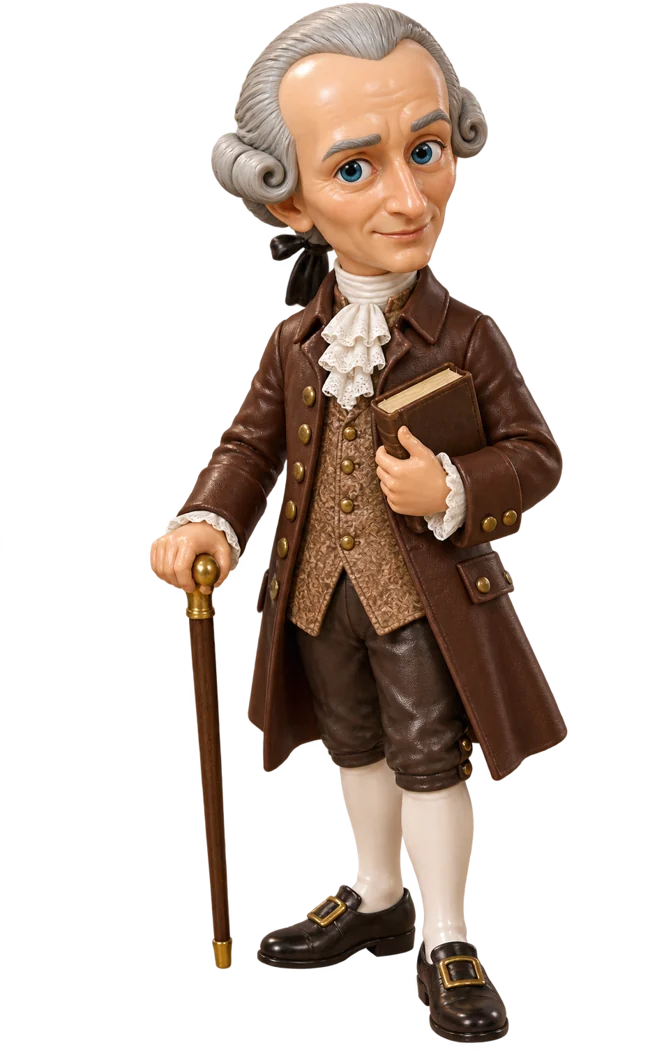
Early modern · person
Immanuel Kant
In 1781 a 57-year-old professor in Königsberg published an 800-page book so dense that its first readers were baffled, and it went on to change philosophy for good.
Immanuel Kant was born on 22 April 1724 in Königsberg, in East Prussia, the fourth of nine children of a harness-maker. He was baptised Emanuel and changed the spelling after learning Hebrew. His Pietist family and strict school drilled him in Latin and religion. He entered the University of Königsberg at 16, worked for years as a private tutor after his father's death, and in 1755 described how the Solar System might have formed from a cloud of gas, the nebular hypothesis.
In 1770 he became professor of logic and metaphysics. He later credited the Scottish philosopher David Hume with waking him from his "dogmatic slumber", and he struggled with one problem: how can we know anything for certain before experience? His answer was the Critique of Pure Reason (1781), more than 800 pages long and so dense that its first readers were baffled. Its argument, that space, time and cause are forms our own minds give to experience, changed philosophy. Groundwork of the Metaphysics of Morals (1785) and the Critique of Practical Reason (1788) set out his ethics of duty and the categorical imperative.
In Toward Perpetual Peace (1795) he argued for a world of constitutional republics bound together to keep a lasting peace. He never married and lived by a strict routine; neighbours were said to set their watches by his daily walk. He died in Königsberg on 12 February 1804, saying "Es ist gut", "It is good", and lies in a tomb beside its cathedral.
Read more on Wikipedia
Sources: en.wikipedia.org/wiki/Immanuel Kant


