
Antiquity · person
Hypatia
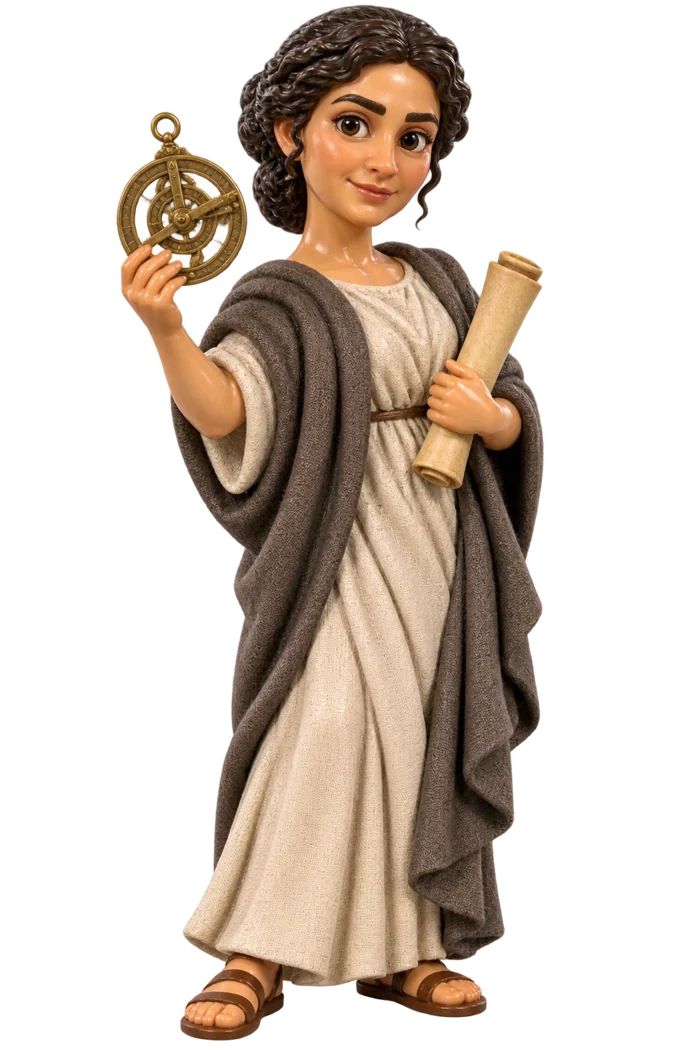
Wrapped in a philosopher's cloak, she walked through Alexandria giving lectures on Plato and Aristotle to anyone who would listen, and every one of her known students was a Christian.
Hypatia was born in Alexandria, then a great city of the Roman Empire, sometime between about 350 and 370. Her father, the mathematician Theon of Alexandria, headed an exclusive and prestigious school, and she was trained in mathematics and astronomy. She is not the first woman mathematician known from Alexandria, but she is the first whose life is reasonably well recorded. No ancient picture of her survives.
She became a famous teacher of Neoplatonist philosophy, lecturing on Plato and Aristotle to students from all over the Mediterranean, and according to Damascius she walked the city in a tribon, the cloak of philosophers, giving lectures in public. Although she was a pagan, every one of her known students was a Christian; one of them, Synesius of Cyrene, became a bishop and kept writing to her, and his letters are the main source on her career. She wrote a commentary on the Arithmetica of Diophantus and another on the conic sections of Apollonius, and she may have edited the surviving text of Ptolemy's Almagest. She also built astrolabes and hydrometers.
She became an adviser of Orestes, the Roman prefect, who was feuding with Cyril, the bishop of Alexandria. Rumours spread that she was keeping them apart, and in March 415 she was killed by a Christian mob led by a lector named Peter. Her death shocked the empire. Later ages made her a martyr for philosophy, and in the 20th century an icon of women's rights.
Read more on Wikipedia
Sources: en.wikipedia.org/wiki/Hypatia


