Middle Ages · state
Hungarians
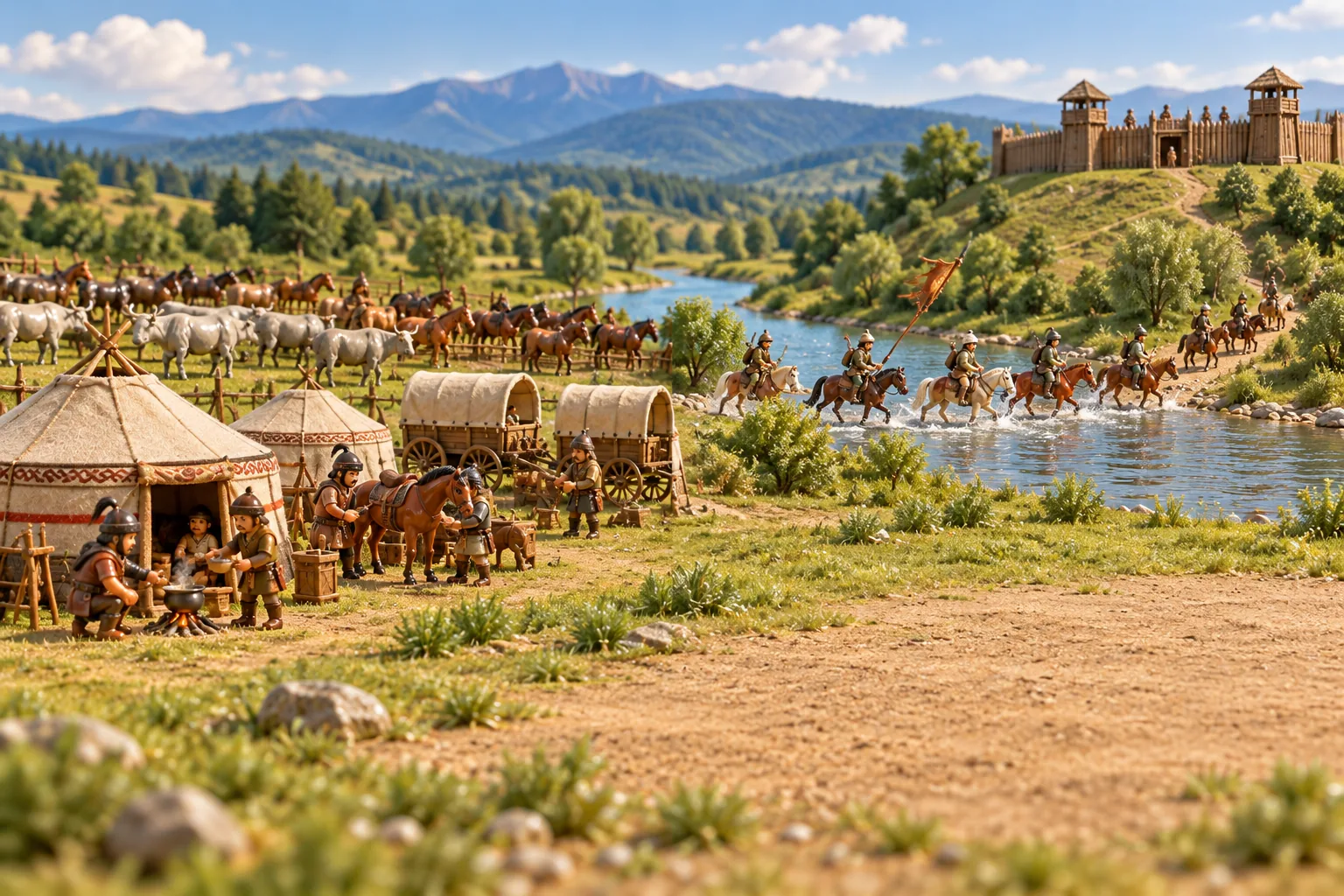
Around 895 seven Magyar tribes crossed the Carpathians and settled a plain where people still speak a language unrelated to their neighbours'.
Hungarian belongs to the Ugric branch of the Uralic languages, alongside Khanty and Mansi, and the early Hungarian homeland is placed around the Ural Mountains. By the 9th century the Hungarians lived on the Pontic-Caspian steppe, neighbours of the Bulgars and the Khazars. Around 830 a rebellion broke out in the Khazar khaganate, and three Kabar tribes of the Khazars joined the Hungarians in the Etelköz, the land between the Carpathians and the Dnieper.
Tradition says the Hungarians were a confederacy of seven tribes: Jenő, Kér, Keszi, Kürt-Gyarmat, Megyer, Nyék and Tarján; the name Magyar probably comes from the Megyer. From the 860s they raided into the Carpathian Basin and came to know the land well. Around 895, after the Bulgarians and then the Pechenegs attacked them in the Etelköz, the tribes under Grand Prince Álmos and his son Árpád crossed the mountains and took the basin.
In 907 they destroyed a Bavarian army at Pressburg, and for half a century their fast and devastating raids reached from Denmark to Spain. The Battle of Lechfeld in 955 ended the raids in the west, though raids into the Balkans went on until 970. The leaders then turned to Christianity, and Stephen I was crowned King of Hungary in 1001.
Read more on Wikipedia
Sources: en.wikipedia.org/wiki/Hungarians