
Middle Ages · person
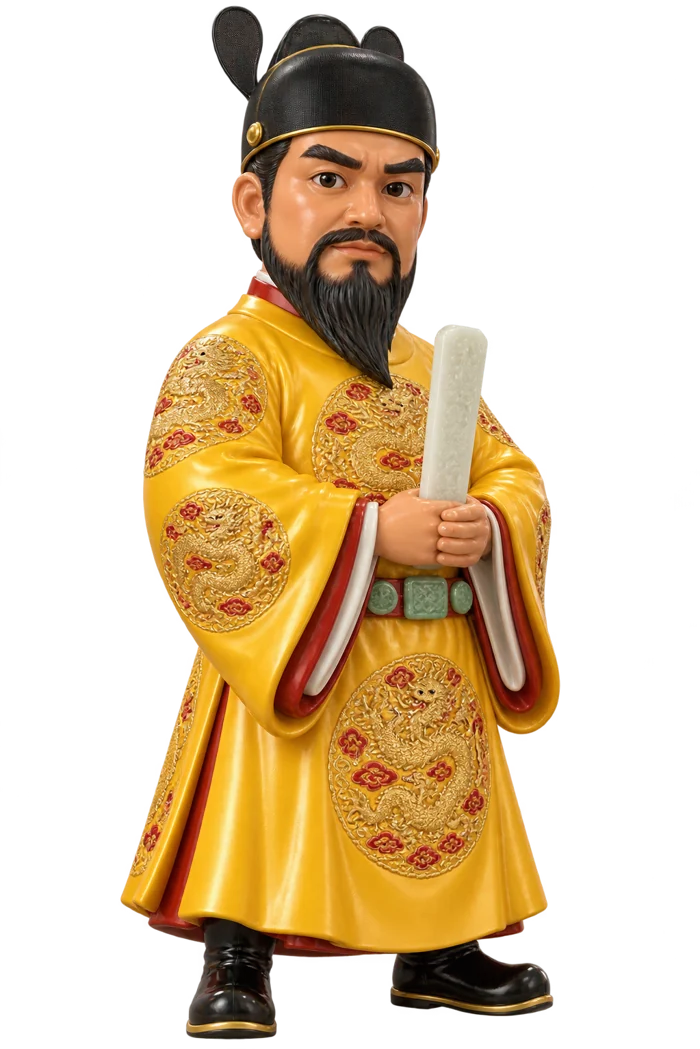
Hongwu Emperor
On 23 January 1368 a man who had once begged for alms as an orphaned novice monk proclaimed himself emperor in Nanjing and named his dynasty the Great Ming.
Zhu Yuanzhang was born on 21 October 1328 in the village of Zhongli in Haozhou, today's Fengyang in Anhui, the youngest of four sons of a poor peasant family under the Mongol Yuan dynasty. In 1344 his parents and a brother died in an epidemic, and he entered a Buddhist monastery. For three years he wandered as a novice monk, begging for alms, then returned and learned to read and write.
In 1352, after Yuan troops burned his monastery, he joined the Red Turban rebels at Haozhou under Guo Zixing and married Guo's adopted daughter, the future Empress Ma. He rose fast, took Nanjing in 1356 and defeated his rival Chen Youliang at the Battle of Lake Poyang in September 1363. On 23 January 1368 he proclaimed himself emperor of the Great Ming, with Hongwu, "Vastly Martial", as his era name. That year his armies took Dadu, today's Beijing, and the last Yuan emperor fled north. He rebuilt the country after decades of war, counted its people and land in the Yellow and Fish-Scale Registers, and began the Great Ming Code.
Fearful of plots, he had Grand Chancellor Hu Weiyong executed in 1380, abolished the chancellor's office and ruled the six ministries himself; he also had several of his generals executed. Empress Ma died in 1382. He died on 24 June 1398 and was buried in the Xiao Mausoleum on Purple Mountain east of Nanjing. His grandson succeeded him as the Jianwen Emperor, until his fourth son seized the throne in 1402 as the Yongle Emperor.
Read more on Wikipedia
Sources: en.wikipedia.org/wiki/Hongwu Emperor, en.wikipedia.org/wiki/Ming dynasty