Middle Ages · state
Hephthalites
The 'White Huns' defeated and killed the Persian king Peroz in 484 and took tribute from Sasanian Iran for decades.
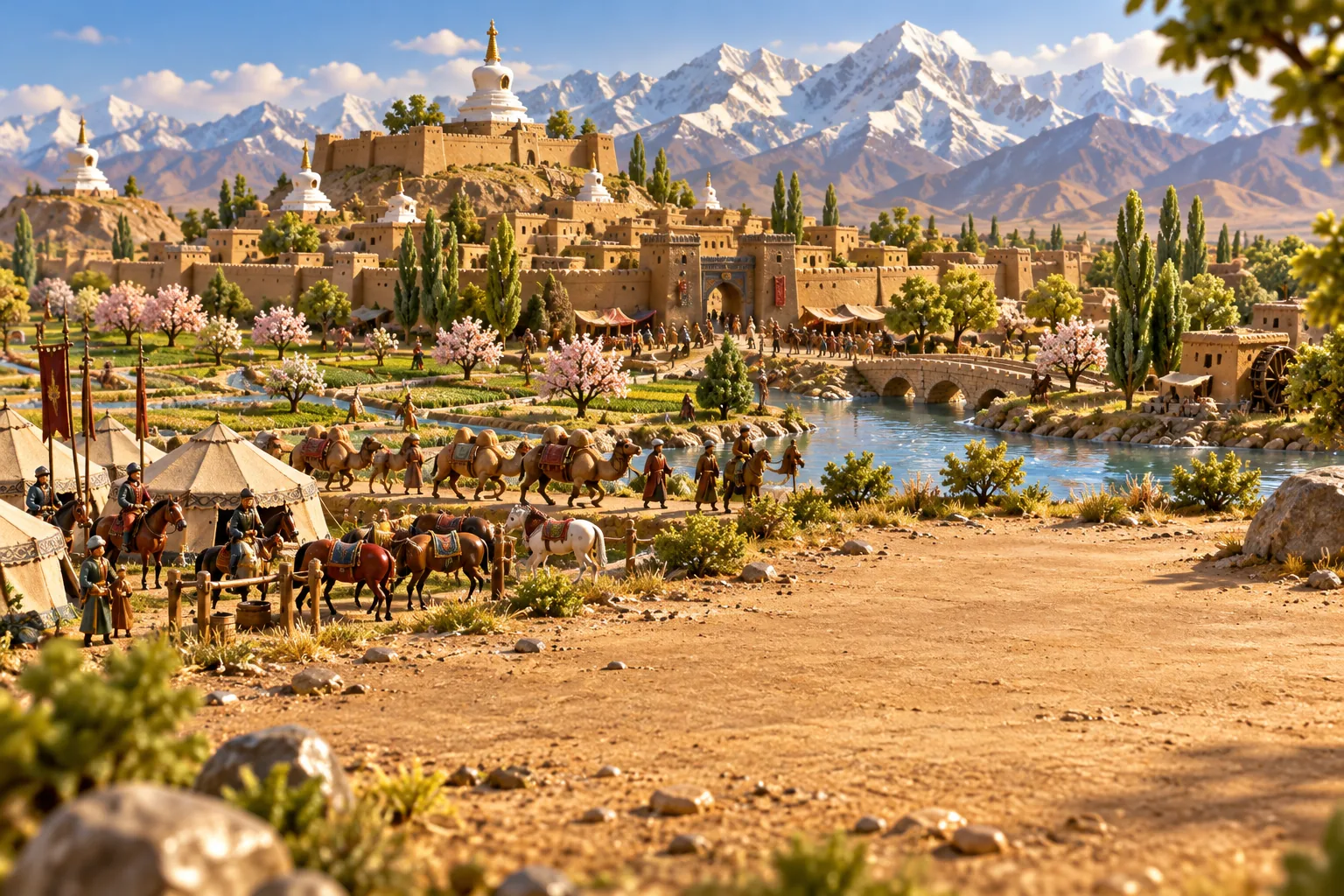
The Hephthalites, whom Indians and Persians called the White Huns, were a confederation of nomads and town dwellers in Tokharistan, on the northern slopes of the Hindu Kush. Their capital was probably at Kunduz. From about 450 they defeated the Kidarites and became the strongest power in the region; by 479 they had conquered Sogdia, and by 493 they had reached the Tarim Basin.
At first they were allies of Sasanian Persia: in 458 the Hephthalite king Akhshunwar helped Peroz I win the throne from his brother. But from 474 Peroz fought them three times. After his second defeat he had to send thirty mules loaded with silver coins and leave his son Kavad as a hostage, and in 484, at the Battle of Herat, he was defeated and killed. Persia paid them tribute from 474 until the middle of the sixth century, and the Hephthalites copied Peroz's winged crown on their own coins. In 488 a Hephthalite army put Kavad on the Persian throne, and when he was overthrown he fled to them and returned with their troops.
Around 560 an alliance of the First Turkic Khaganate and the Sasanian Empire destroyed their empire. Some Hephthalites stayed on as local rulers in Tokharistan for another 150 years, and the giant Buddhas of Bamiyan were begun under Hephthalite rule.
Read more on Wikipedia
Sources: en.wikipedia.org/wiki/Hephthalites

