
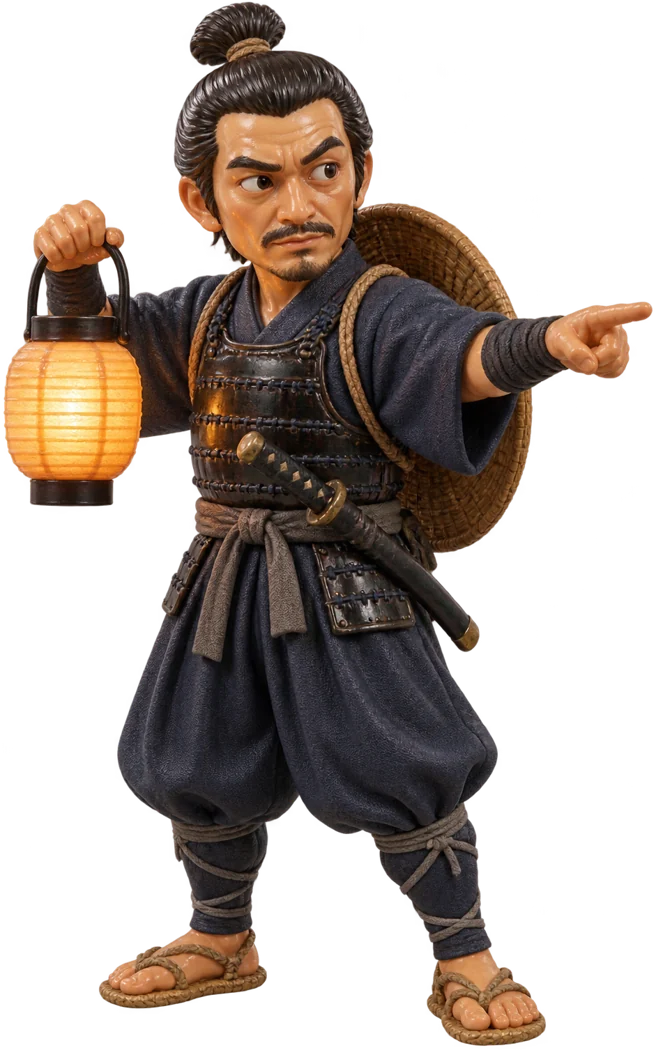
Early modern · person
Hattori Hanzō
In June 1582, with Nobunaga dead and samurai-hunting gangs on every road, Tokugawa Ieyasu crossed the mountains of Iga with 34 companions. One of them was Hanzō.
Hattori Hanzō, whose real name was Hattori Masanari, was born around 1542 in Mikawa Province, the son of Hattori Yasunaga, the first Hanzō, a minor samurai serving the Matsudaira clan, later called Tokugawa. His family came from Iga Province, which he often visited. He fought his first battle at 15, in a night attack on Uto Castle in 1557. From 1561 he served the young Tokugawa Ieyasu, and in 1562 he rescued Ieyasu's wife and son, held hostage at Kaminogō Castle.
He fought at Anegawa and Mikatagahara, where he earned the nickname Oni no Hanzō, the Demon Hanzō, and came to lead a unit of Iga warriors. In 1579, when Ieyasu's son Nobuyasu was ordered to commit seppuku, Hanzō refused to strike the final blow, and Ieyasu said, "Even a demon can shed tears." In June 1582, after Oda Nobunaga was killed at Honnō-ji, Ieyasu fled from Sakai with only 34 companions, Hanzō among them, and crossed the dangerous country around Iga home to Mikawa. Later tradition says Hanzō's Iga men guided him, though historians note the story first appears in the 18th century.
Rewarded with a domain of 8,000 koku, he fought on at Komaki and Nagakute and Odawara. He died of illness on 2 January 1597 and is buried at Sainen-ji in Tokyo. The Hanzōmon gate of the Imperial Palace, and the subway line named after it, keep his name.
Read more on Wikipedia
Sources: en.wikipedia.org/wiki/Hattori Hanzō
