Antiquity · state
Han dynasty
A village official who rose in rebellion founded a dynasty that ruled China for four centuries and gave the Chinese people their name.
When the harsh Qin dynasty collapsed, the rebel leader Liu Bang, born a peasant, won the civil war and in 202 BC became emperor. He kept much of the Qin system of officials and provinces but softened its laws, and the dynasty he founded ruled from Chang'an and later from Luoyang.
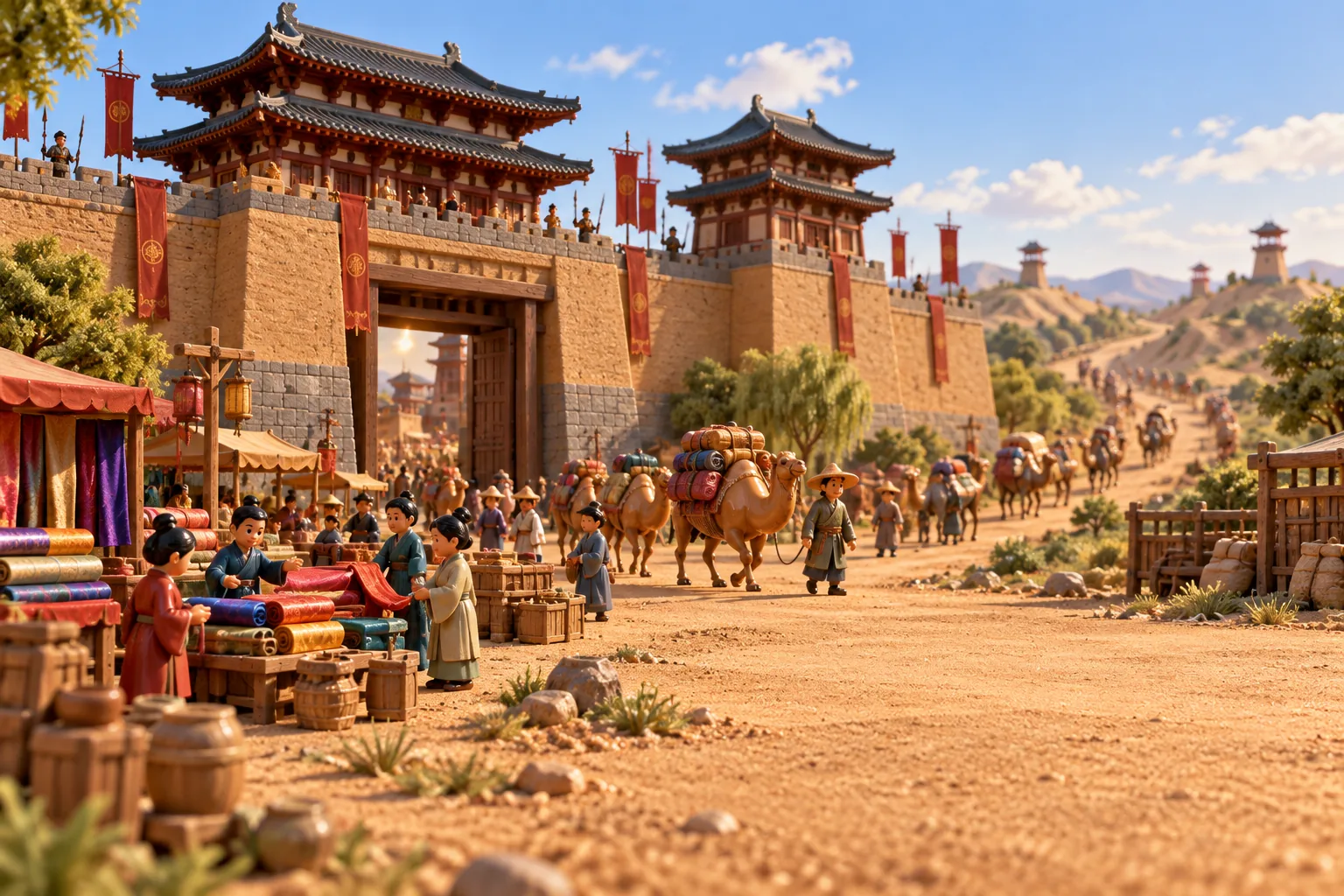
Emperor Wu, who reigned from 141 to 87 BC, fought the Xiongnu nomads of the north, pushed the borders into Korea, Vietnam and Central Asia, and made Confucian learning the path into government service. His envoy Zhang Qian travelled far to the west, and the routes he opened became the Silk Road, carrying Chinese silk as far as Rome. A census taken in AD 2 counted about 58 million people.
The minister Wang Mang seized the throne in AD 9, but the Han came back in AD 25 and ruled from Luoyang. In those centuries the court official Cai Lun improved papermaking and the astronomer Zhang Heng built a seismoscope. Court intrigue, floods and the Yellow Turban rebellion of 184 broke the dynasty apart, and in 220 the last Han emperor gave up the throne, opening the age of the Three Kingdoms.
Read more on Wikipedia
Sources: en.wikipedia.org/wiki/Han dynasty, en.wikipedia.org/wiki/Zhang Heng, en.wikipedia.org/wiki/Zhang Qian


