
Early modern · person
Guru Nanak
He vanished while bathing in the Bein river and was given up for drowned; when he came back days later, his first words were "There is no Hindu, there is no Muslim".
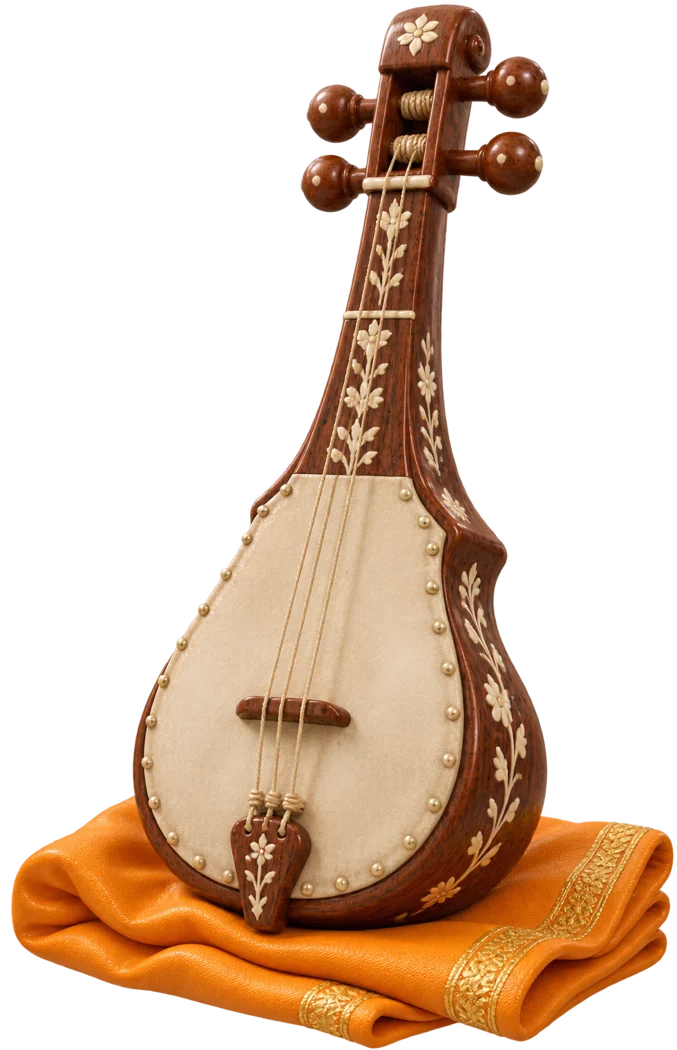
Nanak was born on 15 April 1469 in the village of Rai Bhoi di Talwandi, today Nankana Sahib in Pakistan, in the Lahore province of the Delhi Sultanate. His childhood friend Mardana was a Muslim musician who played the rabab. On 24 September 1487 he married Sulakhani in Batala, and they had two sons, Sri Chand and Lakhmi Das.
As a young man he moved to Sultanpur Lodhi, where his elder sister Nanaki lived, and through her husband found work in the storehouse of the governor Daulat Khan Lodi. According to Sikh tradition, one morning he disappeared into the Bein river while bathing. On the third or fourth day he returned, silent, and answered every question with "There is no Hindu, there is no Muslim". From then on he taught Ik Onkar, one God who dwells in all creation, and the traditional biographies send him, with Mardana playing the rabab, on four long journeys: as far as Sri Lanka, Tibet and Mecca. Coming back, he witnessed Babur's armies invading at Saidpur and wrote of it in four hymns.
Around the age of 55 he settled at Kartarpur on the Ravi, living as a householder among his followers, who sang hymns at dawn and ate together in the langar, a shared kitchen open to every caste. He chose his disciple Bhai Lehna as his successor, naming him Guru Angad, and died at Kartarpur on 22 September 1539, aged 70. His 974 hymns stand in the Guru Granth Sahib, and he is the first of the ten Sikh Gurus.
Read more on Wikipedia
Sources: en.wikipedia.org/wiki/Guru Nanak, en.wikipedia.org/wiki/Sikhism