Antiquity · state
Greco-Bactrian Kingdom
Greek kings ruled Afghanistan for more than a century, building theatres on the Oxus and minting the largest gold coin of the ancient world.
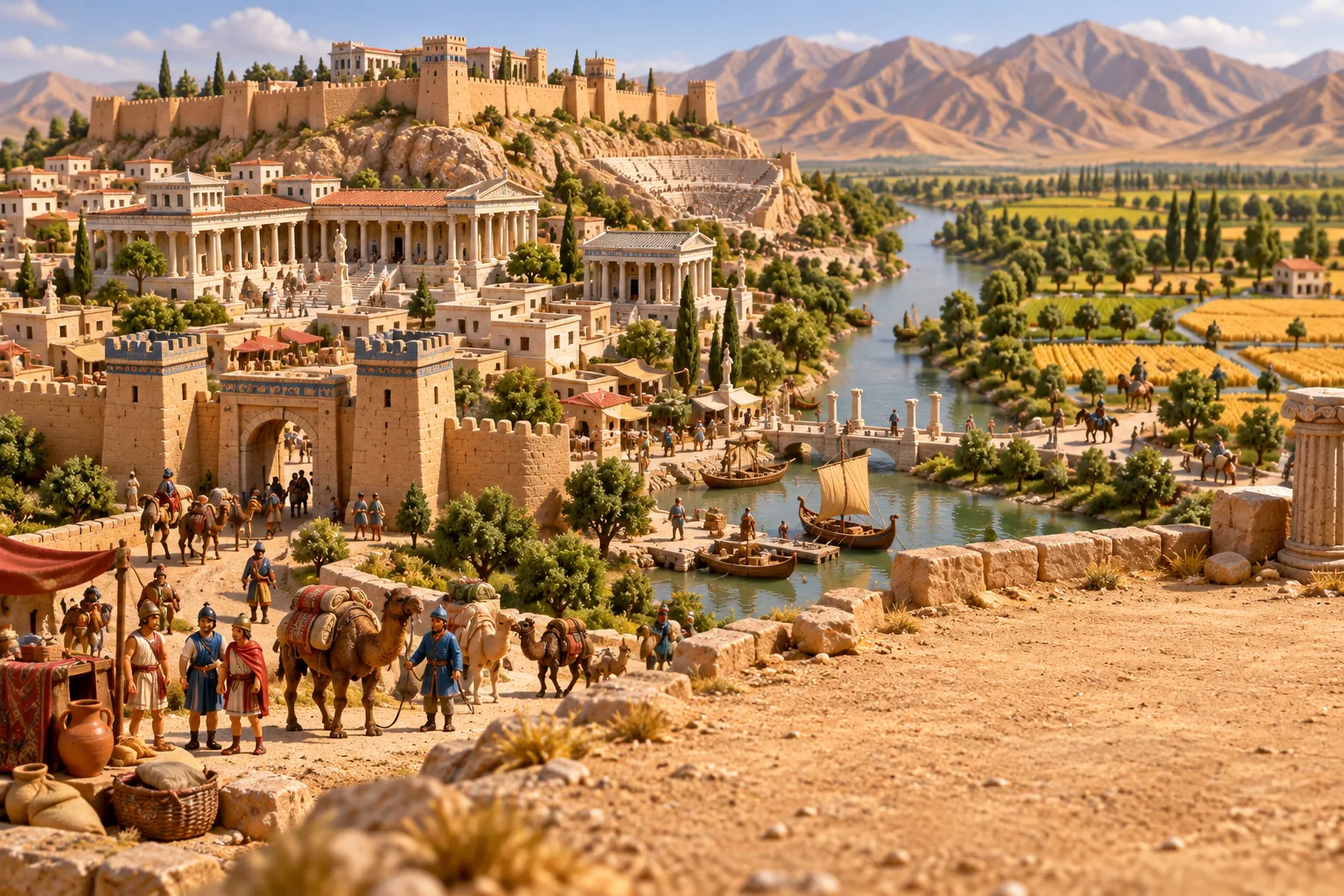
Alexander the Great conquered Bactria, today's northern Afghanistan, by 327 BC and settled Macedonians and other Greeks in new cities. Around 250 BC its Seleucid governor Diodotus broke away and made himself king. The Roman historian Justin called it the extremely prosperous Bactrian empire of the thousand cities. Around 230–220 BC Euthydemus, a Greek from Magnesia, seized the throne, and when the Seleucid king Antiochus III attacked him, he held out through a three-year siege of Bactra until Antiochus recognised him.
His son Demetrius invaded the Indian subcontinent before 180 BC. Around 171 BC Eucratides took power in a coup, campaigned deep into north-western India and probably made Ai-Khanoum on the Oxus his capital. The city had a great palace, a gymnasium and a theatre for five to six thousand people. Justin wrote that, coming home from India, Eucratides was killed by his own son and co-ruler, who drove his chariot over his father's blood.
Weakened by wars with Parthia, Bactria lay open to the steppe. Saka nomads invaded around 140 BC, followed by the Yuezhi. When the Chinese envoy Zhang Qian came around 126 BC, he found Bactria with no great ruler, only petty chiefs. The Yuezhi stayed, took up the Greek alphabet and later founded the Kushan Empire.
Read more on Wikipedia
Sources: en.wikipedia.org/wiki/Greco-Bactrian Kingdom, en.wikipedia.org/wiki/Ai-Khanoum, en.wikipedia.org/wiki/Eucratides I


