Early modern · state
Grand Principality of Moscow
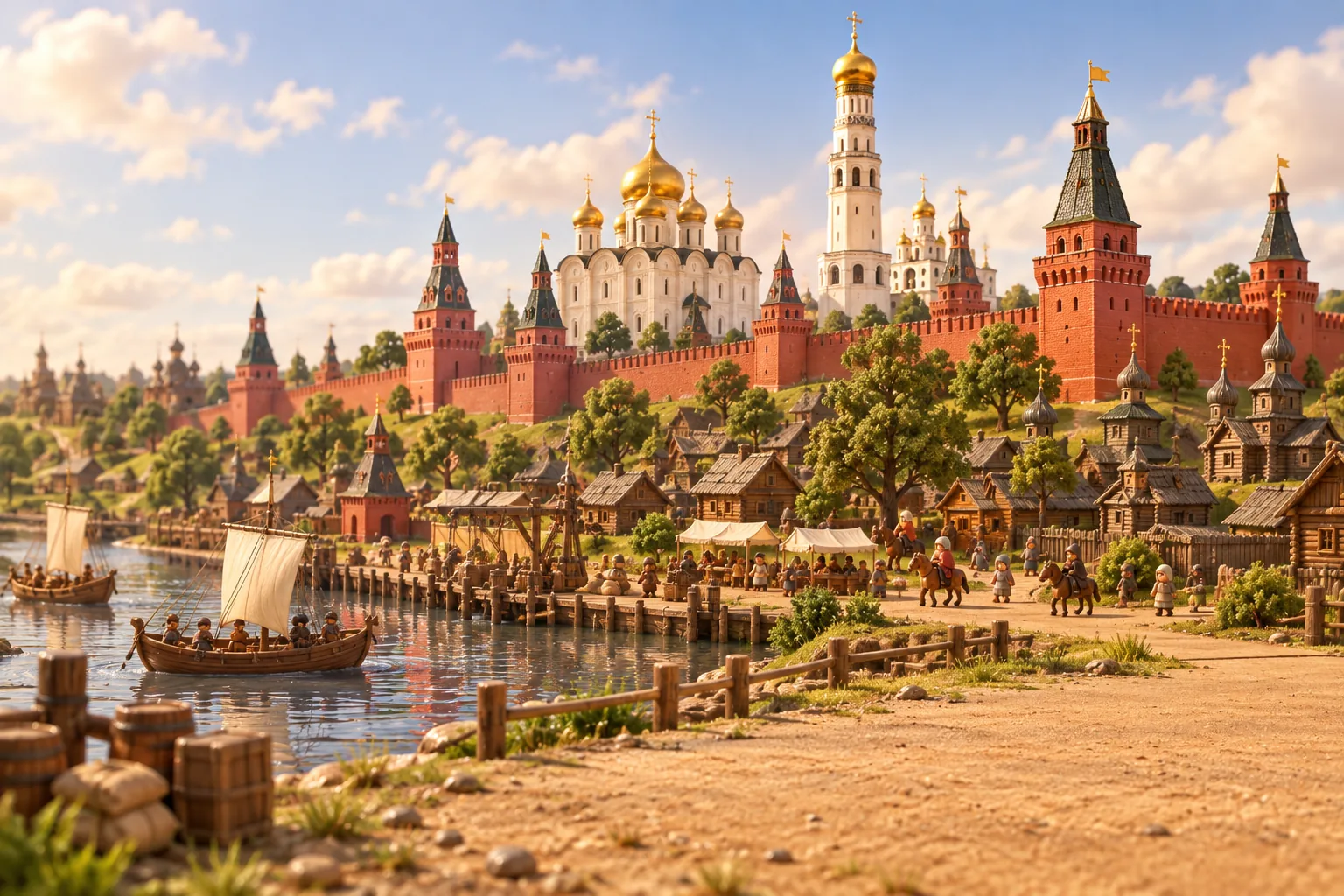
Moscow began as a minor town paying tribute to the Mongols, and in 1480 its grand prince Ivan III faced down the Horde on the Ugra River without a real battle.
Moscow is first mentioned in 1147 and was sacked during the Mongol invasion of 1237–1238. Daniel, the youngest son of Alexander Nevsky, received it as his own principality, and in 1301 he took Kolomna from Ryazan. His son Ivan I, called Kalita, became grand prince under the khan of the Golden Horde and collected the khan's tribute from other Russian princes. In 1325 Metropolitan Peter moved his residence to Moscow, making it the seat of the Russian Church.
Dmitry Donskoy defeated the Tatar leader Mamai at Kulikovo in 1380, although Tokhtamysh sacked Moscow two years later. Ivan III, who reigned from 1462 to 1505, gathered the Russian lands: his army beat Novgorod in 1471, ended its self-rule in 1478 and took Tver in 1485. Russia stopped paying tribute in 1476, and in 1480 a Tatar army withdrew after a standoff on the Ugra River. Ivan issued the Sudebnik law code in 1497 and brought the Italian architect Aristotele Fioravanti to build a new Dormition Cathedral in the Kremlin.
Vasily III annexed Pskov in 1510, took Smolensk from Lithuania in 1514 and absorbed Ryazan in 1521. He died in 1533, leaving a three-year-old son, and boyar clans fought for power around the regent Elena Glinskaya. In 1547 that son, Ivan IV, was crowned tsar of all Russia, and the grand principality became the Tsardom of Russia.
Read more on Wikipedia
Sources: en.wikipedia.org/wiki/Grand Principality of Moscow, en.wikipedia.org/wiki/Great Stand on the Ugra River