Middle Ages · state
Grand Duchy of Lithuania
Europe's last pagan state stretched from the Baltic to the Black Sea before its grand duke Jogaila accepted baptism and the Polish crown in 1386.
Pagan Lithuanian tribes began raiding their Slavic neighbours around 1180, and the threat of the crusading Livonian Order and Teutonic Knights pushed them together. By the mid-1230s the duke Mindaugas held supreme power. He was baptised in 1251 and crowned King of Lithuania on 6 July 1253, but later broke with the Christians and was murdered in 1263.
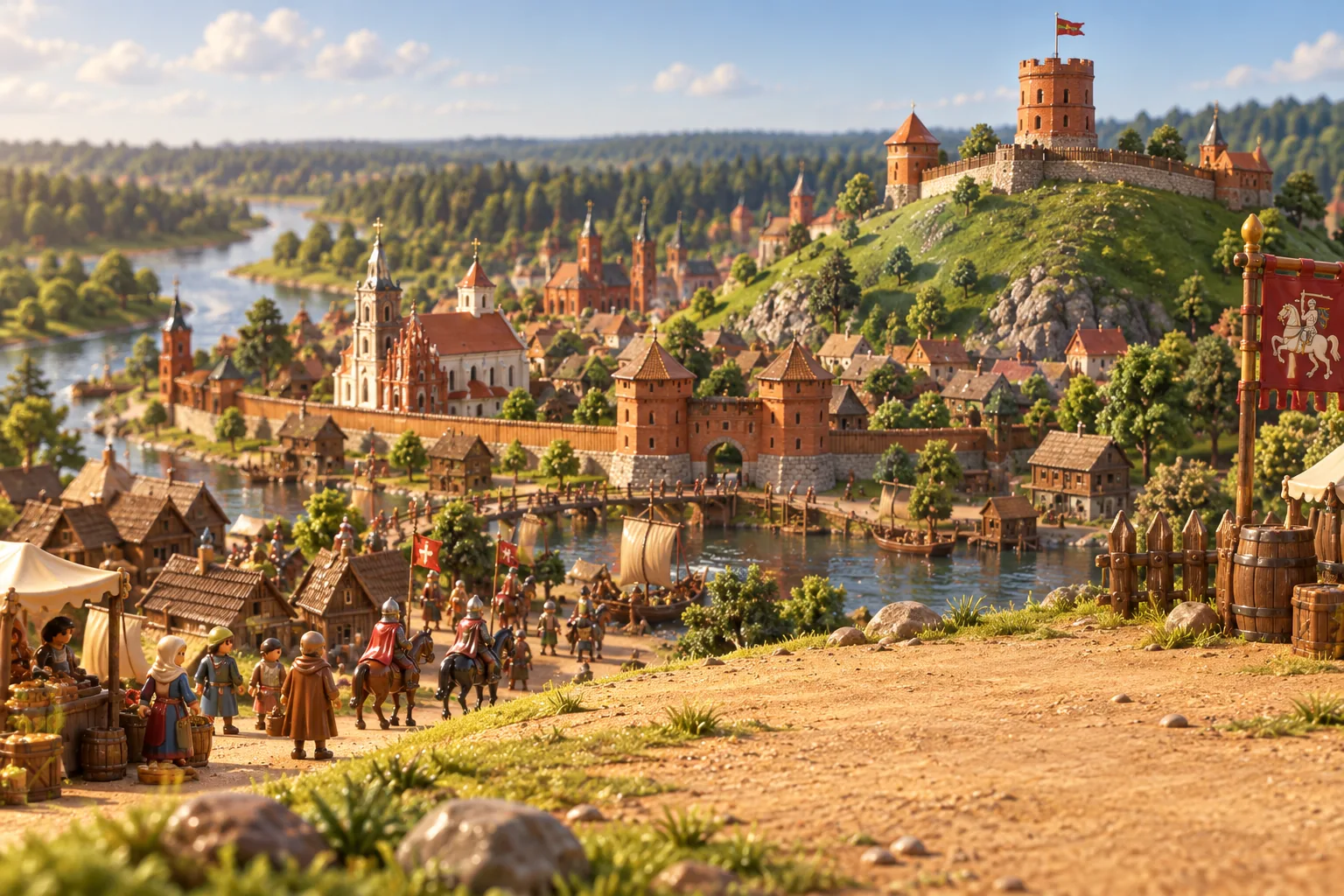
Grand Duke Gediminas took Kiev in 1321 and fixed the capital at Vilnius around 1323. His sons Algirdas and Kęstutis pushed south into the lands of the old Kievan Rus' as the Golden Horde weakened, and beat a Horde army at Blue Waters in 1362. In 1386 Algirdas's son Jogaila signed the Union of Krewo, became King of Poland and brought Europe's last pagan state into Christianity. His cousin Vytautas the Great, grand duke from 1401 to 1430, led Lithuanian troops in the joint victory over the Teutonic Order at Grunwald in 1410. By 1440 the grand duchy was the largest state in Europe.
Moscow grew into a rival and took large lands in wars around 1500, and even the victory at Orsha in 1514 did not stop the losses. To survive, Lithuania joined Poland in the Union of Lublin of 1569, forming the Polish–Lithuanian Commonwealth, in which it kept its own laws, army and treasury. Russia, Prussia and Austria carved up the Commonwealth, and in 1795 the grand duchy disappeared.
Read more on Wikipedia


