
Early modern · politics
French Revolution
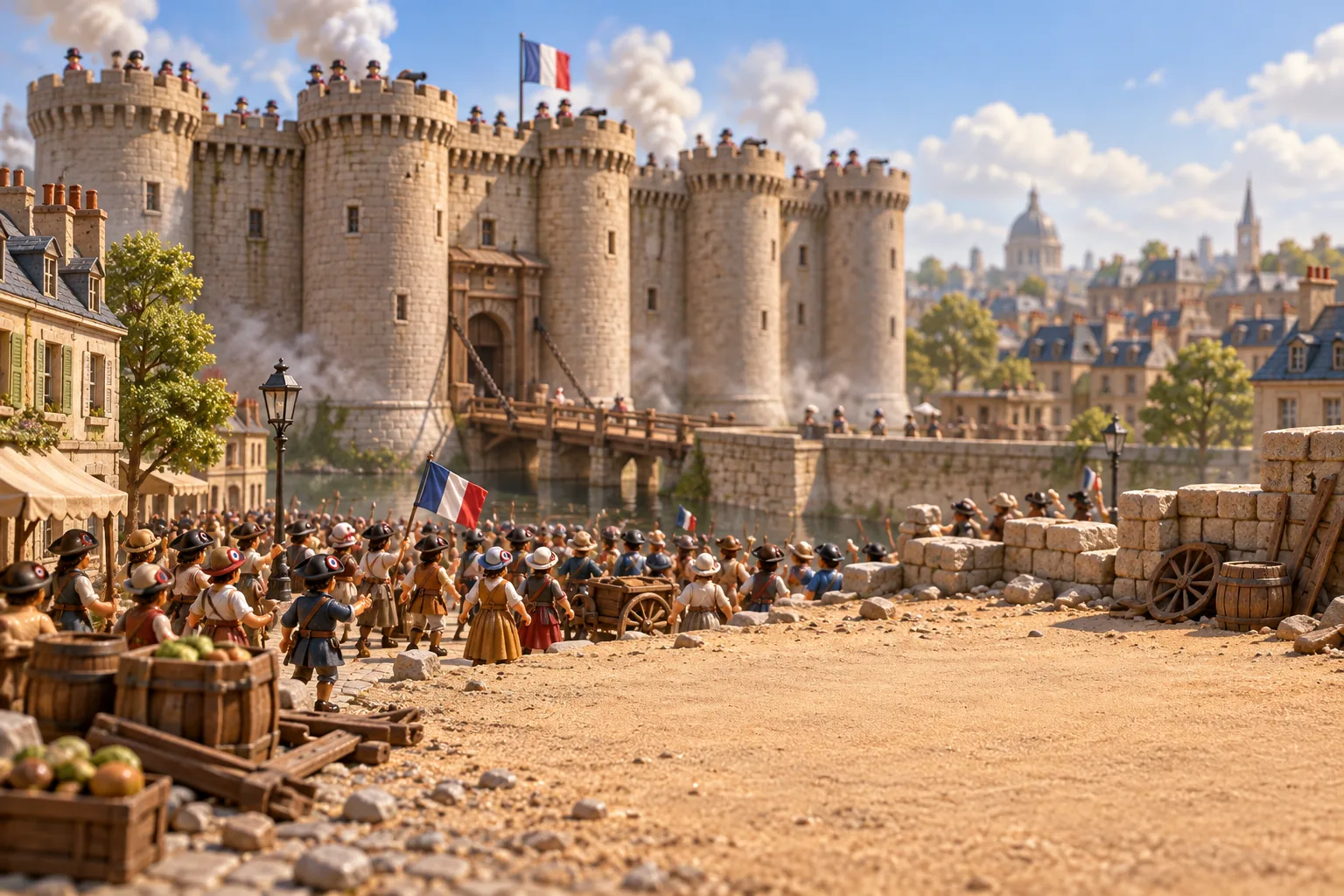
The crowd that stormed the Bastille wanted its gunpowder, and found only seven prisoners inside.
By 1789 France was nearly bankrupt, drained by the cost of backing the American Revolution, unfair taxes and a run of poor harvests. King Louis XVI called the Estates General, an assembly that had not met since 1614, to fix the finances. Instead the commoners' representatives declared themselves a National Assembly and swore the Tennis Court Oath, promising not to disperse until France had a constitution.
In July the king dismissed his popular finance minister, Jacques Necker, and Parisians feared that the royal troops massing around the city would shut the Assembly down. On the morning of 14 July 1789 crowds seized around 30,000 muskets from the Invalides, but there was no powder. The gunpowder had just been moved to the Bastille, the medieval fortress and royal prison in the east of the city. The crowd surrounded it, and after four hours of fighting and 94 deaths the governor, Bernard-René de Launay, surrendered. He and several of his men were killed afterwards.
The fall of the Bastille set the revolution in motion. Within weeks the Assembly abolished feudalism and adopted the Declaration of the Rights of Man and of the Citizen. In September 1792 the monarchy was replaced by a republic, and in January 1793 Louis XVI was executed. Years of war and terror followed until Napoleon Bonaparte took power in November 1799. The 14th of July is France's national holiday.
Read more on Wikipedia
Sources: en.wikipedia.org/wiki/French Revolution, en.wikipedia.org/wiki/Storming of the Bastille