Early modern · state
French Guiana
France's penal colony here swallowed more than 80,000 convicts, among them Alfred Dreyfus, and the same coast now launches Europe's rockets.
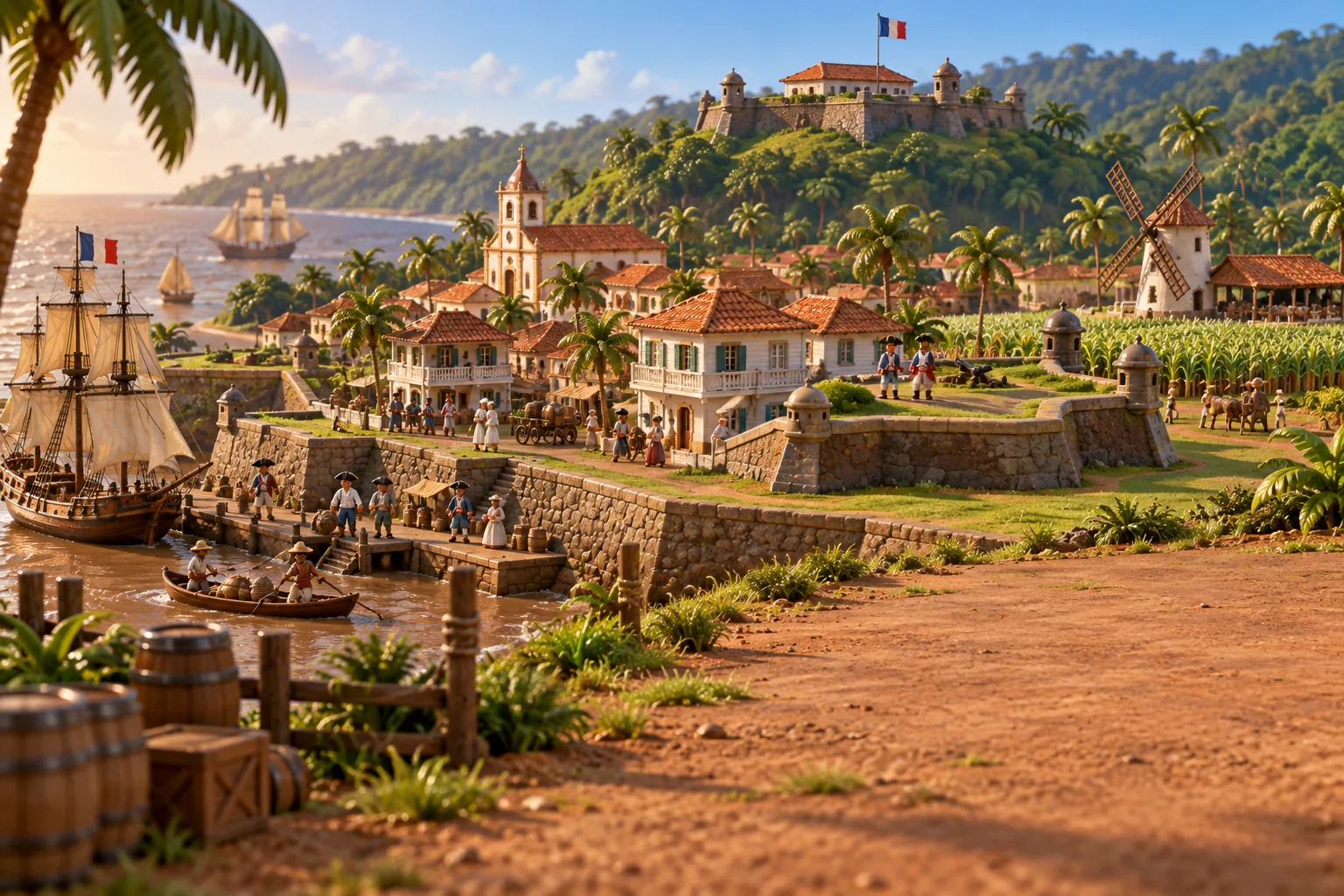
Before the Europeans came, the coast and forests belonged to the Kalina, Lokono, Palikur, Teko, Wayampi and Wayana peoples. A French post is recorded as early as 1503, but a lasting colony began only when settlers founded Cayenne in 1643. It grew into a slave society, where planters made enslaved Africans work on sugar plantations. In February 1794 the revolutionary National Convention abolished slavery in the colonies, and French Guiana was one of only three colonies where the decree was carried out.
In 1809 a Portuguese and British squadron took the colony for Portugal, and it was handed back to France by the Treaty of Paris in 1814. From 1852 France made it a penal colony, with prisons on the mainland and on three offshore islands, the most notorious being Devil's Island. Most of the more than 80,000 prisoners sent there never returned. Captain Alfred Dreyfus, falsely convicted of treason, arrived on 5 January 1895. Transports stopped in 1938 and the last prison closed in 1953.
In 1936 Félix Éboué from Cayenne became the first black governor of a French colony. On 19 March 1946 French Guiana became a French department. In 1964 Charles de Gaulle chose Kourou, close to the equator, for France's spaceport, The first satellite went up from there in 1970, and Europe's Ariane rockets followed.
Read more on Wikipedia
Sources: en.wikipedia.org/wiki/French Guiana, en.wikipedia.org/wiki/Devil's Island, en.wikipedia.org/wiki/Guiana Space Centre, en.wikipedia.org/wiki/Cayenne pepper

