Early modern · war
French and Indian War
A 22-year-old Virginia militia officer named George Washington fired one of the first shots of a war that would end with France losing almost all of North America.
In the 1750s Britain and France were officially at peace, but they both claimed the land between their colonies, above all the Forks of the Ohio, where the French built Fort Duquesne. On 28 May 1754 Virginia militia under the young George Washington ambushed a French patrol at Jumonville Glen. Washington then built Fort Necessity, where he was forced to surrender on 3 July. In 1755 the British general Edward Braddock marched on Fort Duquesne, but his army was routed at the Monongahela and he died of his wounds.
For the first years the French, led from 1756 by the Marquis de Montcalm and fighting alongside many Indigenous nations, held the upper hand. The British meanwhile began expelling the French Acadians from Nova Scotia. Then William Pitt became Britain's leader and poured soldiers and money into America, while France preferred to concentrate its forces in Europe. In 1758 the British took Louisbourg and Fort Duquesne, and in 1759 Ticonderoga and Fort Niagara.
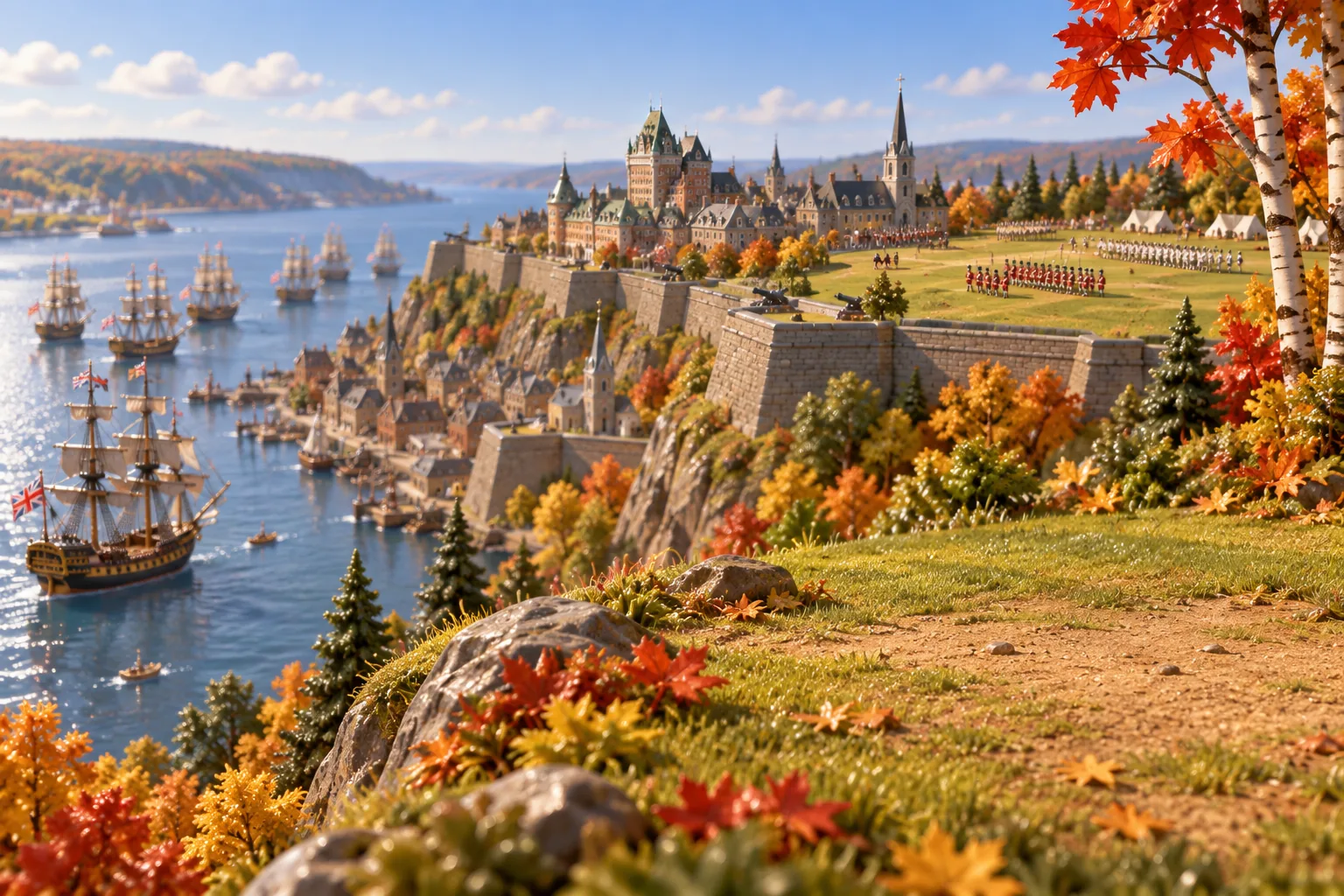
In September 1759 James Wolfe defeated Montcalm on the Plains of Abraham outside Quebec. Both commanders were killed, and the city surrendered. Montreal fell in 1760. By the Treaty of Paris in 1763 France gave Canada and its lands east of the Mississippi to Britain, and it handed Louisiana west of the river to Spain. Of all New France, only the small islands of Saint Pierre and Miquelon stayed French.
Read more on Wikipedia


