Prehistory · people
First steps out of Africa
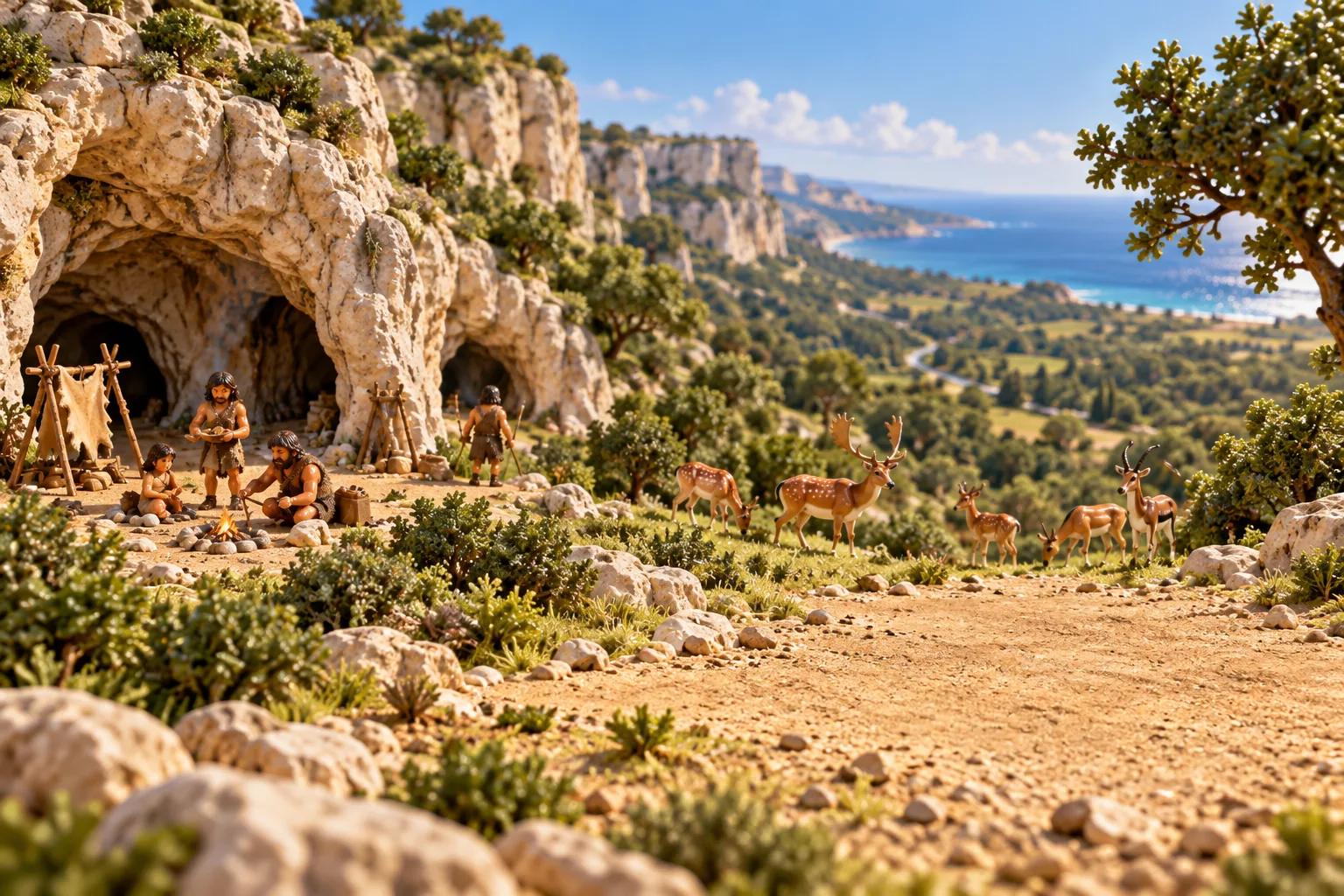
A teenager buried in a cave near Nazareth about 95,000 years ago was laid to rest with the antlers of a red deer clasped to the chest.
In 1928 the British authorities in Palestine planned to quarry the cliffs of Mount Carmel for stone to build a harbour at Haifa. Archaeologists got there first. From 1929 Dorothy Garrod led excavations in the valley's caves, and in Skhul Cave the American Theodore McCown dug out the skeletons of seven adults and three children between 1931 and 1935. Thirty-five kilometres to the east, near Nazareth, the French consul René Neuville began excavating Qafzeh Cave in 1934. In total it gave up 15 individuals, 8 of them children.
At first the skulls were puzzling: heavy brow ridges and jutting jaws, but the rounded braincase of modern people. Skhul 5 was long taken for an advanced Neanderthal. Today the Skhul and Qafzeh people are classed as Homo sapiens, among the earliest of our species outside Africa. Dating since 1988 has put them at roughly 80,000 to 115,000 years old, more than twice as old as once thought.
They were not the ones who went on to settle the world. They were part of an early move out of Africa, and in the Levant modern humans were later replaced by Neanderthals, who seem to have lived in the region at around the same time. A second dispersal from Africa, about 70,000 years ago, would carry our species much further.
Read more on Wikipedia