
Prehistory · culture
First patterns
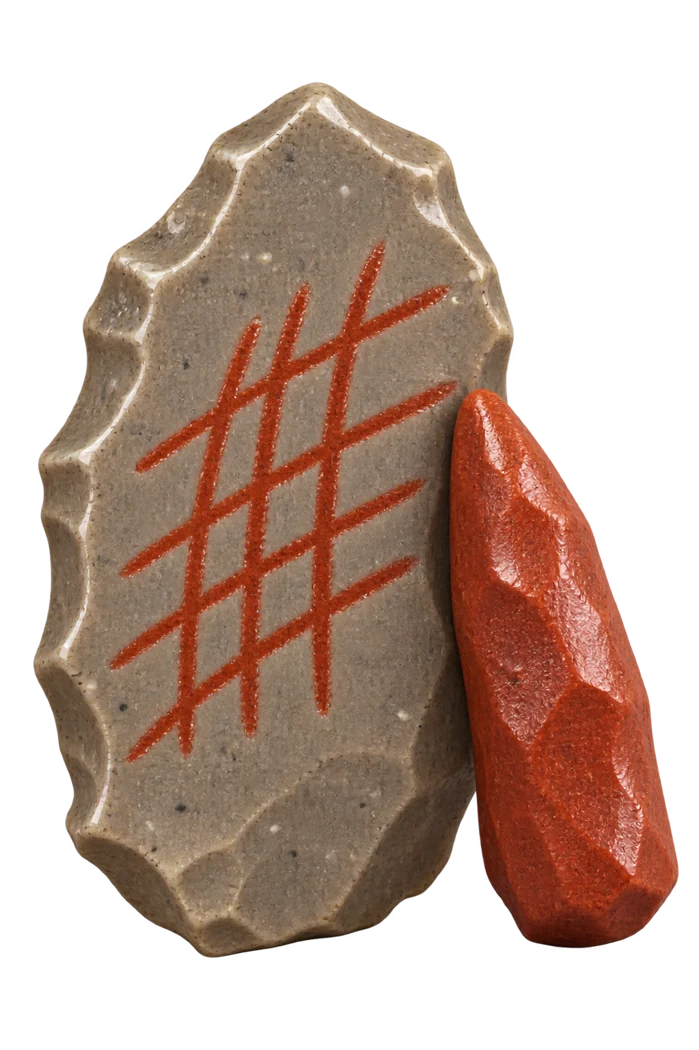
Nine red lines on a flake of stone, drawn with an ochre crayon some 73,000 years ago, are the oldest known drawing by a human hand.
Blombos Cave sits in a cliff on the southern coast of South Africa, about 300 km east of Cape Town. Between about 100,000 and 70,000 years ago, people of our own species lived there, ate shellfish, tortoises and ostrich eggs, and made fine stone spear points and bone tools. Since the first dig in 1991, led by Christopher Henshilwood, the cave has changed what archaeologists think about when humans began to think in symbols.
The cave held more than 8,000 pieces of ochre, an iron-rich red mineral. Some had been scraped smooth and deliberately engraved with crosshatched patterns and parallel lines, among the clearest early examples of abstract design. In 2011 the team found a small flake of stone among spear points. Seven years of tests showed that nine red lines on it, crossing in a hatched pattern, had been drawn by hand with an ochre crayon about 73,000 years ago. The lines stop abruptly at the edges, so the pattern once ran across a larger surface.
People here also wore jewellery. More than 70 tiny sea-snail shells, pierced, probably with a bone tool, show wear from being strung on cord and worn. Together these finds suggest that the habits we call modern, decoration, symbols and planning, were already present in southern Africa long before the famous cave art of Europe.
Read more on Wikipedia
Sources: en.wikipedia.org/wiki/Blombos Cave