Middle Ages · war
First Crusade
A pope's sermon in a French field sent tens of thousands of people walking 3,000 kilometres to a city most of them had never seen.
In March 1095 the Byzantine emperor Alexios I Komnenos sent envoys to Pope Urban II asking for help against the Seljuk Turks, who had overrun much of Anatolia. On 27 November, at the Council of Clermont in France, Urban answered with a sermon that called on Christians to take up an armed pilgrimage to the East, promising remission of sins to those who died on it. According to one account the crowd shouted "Deus lo volt!", God wills it.
The first to leave were crowds of mostly poor people led by the preacher Peter the Hermit. On the way some bands attacked the Jewish communities of the Rhineland, and in October 1096 Turkish archers destroyed the People's Crusade at Civetot. The great lords followed: Godfrey of Bouillon, Raymond of Toulouse, Bohemond of Taranto and others, with perhaps 100,000 people including non-combatants. They took Nicaea in June 1097, won at Dorylaeum, and besieged Antioch for eight months before it fell in June 1098.
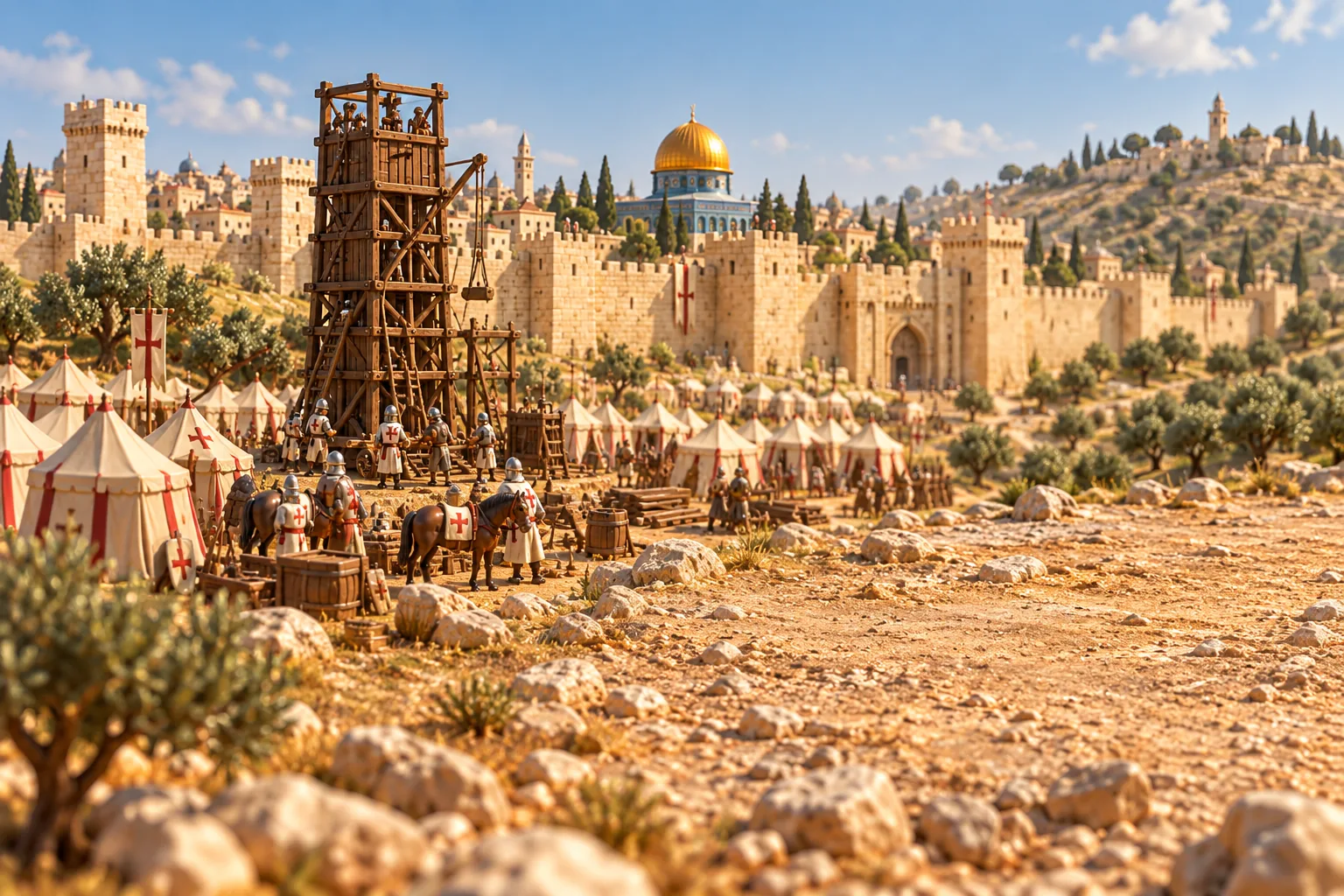
Only about 12,000 men were left when the army reached Jerusalem, then held by the Fatimids of Egypt, on 7 June 1099. Genoese sailors brought timber from their ships for siege towers, and on 15 July the crusaders broke over the northern wall. A massacre of Muslims and Jews followed. Godfrey became ruler with the title Defender of the Holy Sepulchre, and four Crusader states were set up in the Levant, the last of which fell in 1291.
Read more on Wikipedia
Sources: en.wikipedia.org/wiki/First Crusade


